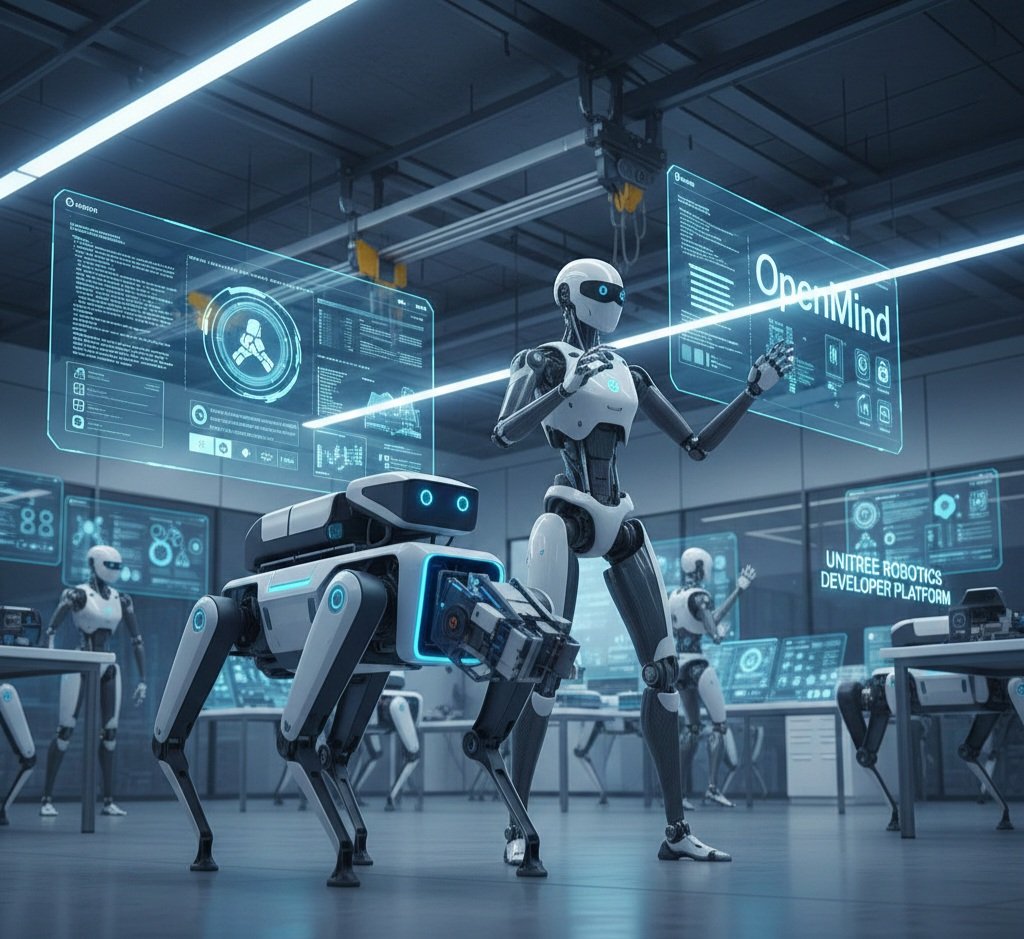
Revolutionizing Robotics: OpenMind AGI and Unitree’s Partnership for Open-Source Innovation
In the rapidly evolving world of artificial intelligence and robotics, collaborations between innovative companies are key to driving progress. Recently, OpenMind AGI announced an exciting partnership with Unitree, a leader in robotic hardware, to advance open-source robotics and integrate smarter machines into everyday environments. This alliance combines Unitree’s expertise in developing advanced quadruped and humanoid robots with OpenMind’s cutting-edge AI capabilities, promising to usher in a new era of intelligent, accessible robotics.
At the heart of this partnership is a shared vision for open-source technology. Open-source robotics allows developers, researchers, and enthusiasts worldwide to contribute to and benefit from collective advancements, democratizing access to sophisticated tools that were once the domain of well-funded labs. By partnering, OpenMind AGI and Unitree aim to create an ecosystem where hardware and software evolve together, fostering innovation that can be applied in real-world scenarios such as search and rescue, industrial automation, and even household assistance.
Unitree, known for its high-performance robotic platforms, brings to the table hardware like the Go2 quadruped and the G1 humanoid. The Go2 is a versatile four-legged robot designed for agility and stability, capable of navigating challenging terrains with ease. Its applications range from exploration in hazardous environments to entertainment and education. On the other hand, the G1 humanoid represents a step towards more anthropomorphic robots, with capabilities for bipedal movement, manipulation, and interaction that mimic human behaviors. These hardware foundations provide a robust base for integrating advanced AI.
OpenMind AGI contributes its intelligence layer through OM1, an AI-native system designed to imbue robots with cognitive abilities. OM1 enables machines to perceive their surroundings, make decisions, learn from experiences, and interact intelligently with humans and other systems. This isn’t just about programming predefined actions; it’s about creating adaptive, learning entities that can evolve over time. The synergy between Unitree’s hardware and OpenMind’s software is poised to produce robots that are not only physically capable but also intellectually sophisticated.

The announcement of this partnership has generated buzz in the tech community, as evidenced by the enthusiastic responses on social media. Users have expressed excitement about the potential for open-source robotics to shape the future, with comments highlighting the ecosystem’s real-world intelligence. This collaboration is more than a business deal; it’s a step towards making advanced technology accessible and beneficial for society at large.
The Business Angle: Opportunities and Impacts
From a business perspective, this partnership opens up numerous opportunities. For Unitree, aligning with OpenMind AGI means enhancing their hardware with state-of-the-art AI, potentially increasing market appeal and expanding their customer base. Unitree’s robots, already popular in research and development circles, could see broader adoption in commercial sectors like logistics, healthcare, and entertainment.
OpenMind AGI, on the other hand, gains access to proven hardware platforms to test and deploy their AI solutions. This real-world application is crucial for refining AI models, gathering data, and demonstrating practical value to investors and partners. The open-source nature of the project could attract a community of developers, accelerating innovation and reducing development costs through collaborative contributions.
Beyond individual company benefits, the partnership has broader implications for the robotics industry. By promoting open-source standards, it challenges proprietary systems and encourages interoperability. This could lead to faster advancements, lower barriers to entry for startups, and a more vibrant ecosystem overall. Investors are likely to take note, as the fusion of AI and robotics is a hot area with significant growth potential.
The Life Angle: How This Affects Everyday People
While the technical and business aspects are compelling, the real excitement lies in how this partnership could impact daily life. Imagine robots assisting in homes, helping the elderly with mobility, or aiding in disaster response by navigating rubble to find survivors. The Go2 quadruped, enhanced with OM1 AI, could patrol farms for crop monitoring or assist in wildlife conservation by tracking endangered species without human intervention.
The G1 humanoid, with its human-like form, opens doors to companionship robots that provide emotional support or educational tutoring for children. In professional settings, these intelligent machines could handle repetitive tasks, freeing humans for more creative endeavors. This isn’t science fiction; it’s the near future, made possible by collaborations like this one.
Moreover, the open-source approach ensures that these technologies aren’t confined to wealthy nations or corporations. Developers in developing countries could adapt these robots for local needs, such as agricultural automation in rural areas or medical assistance in underserved communities. This democratization of technology has the potential to bridge gaps and improve quality of life globally.
Technical Deep Dive: How It All Works
To understand the partnership’s potential, let’s delve into the technical details. Unitree’s Go2 quadruped features advanced actuators and sensors that allow for dynamic balance and movement. It can trot, jump, and even dance, showcasing its mechanical prowess. The G1 humanoid builds on this with arms, hands, and a torso that enable object manipulation and expressive gestures.
OpenMind’s OM1 integrates seamlessly with these platforms through an AI-native architecture. This means the AI is built from the ground up to operate in robotic embodiments, processing sensory data in real-time and making autonomous decisions. For instance, OM1 could enable the Go2 to learn new terrains by analyzing past traversals, improving its navigation over time.
Key technologies involved include machine learning algorithms for perception and planning, neural networks for natural language processing, and reinforcement learning for skill acquisition. The open-source aspect allows the community to contribute models, datasets, and improvements, accelerating development cycles.
Challenges and Considerations
Of course, no technological advancement is without challenges. Ethical considerations around AI in robotics are paramount, including privacy, job displacement, and safety. The partnership must address these by incorporating ethical guidelines into their open-source framework, ensuring that developments prioritize human well-being.
Technical hurdles, such as battery life, computational efficiency, and robustness in varied environments, will need ongoing attention. However, the collaborative nature of open-source projects positions this partnership well to tackle these issues through collective expertise.
Looking Ahead: The Future of Open-Source Robotics
As OpenMind AGI and Unitree forge ahead, the future looks bright for open-source robotics. This partnership could set a precedent for how AI and hardware companies collaborate, leading to more integrated, intelligent systems. We can expect prototypes, demonstrations, and community events that showcase the capabilities of these enhanced robots.
In conclusion, the alliance between OpenMind AGI and Unitree is a milestone in the quest for smarter, more accessible machines. By combining hardware excellence with AI innovation in an open-source framework, they’re not just building robots—they’re shaping a future where technology enhances human potential. Stay tuned for more developments, and perhaps consider how you might contribute to this exciting ecosystem.
(Word count: 1024)


 Robot Central
Leave a comment