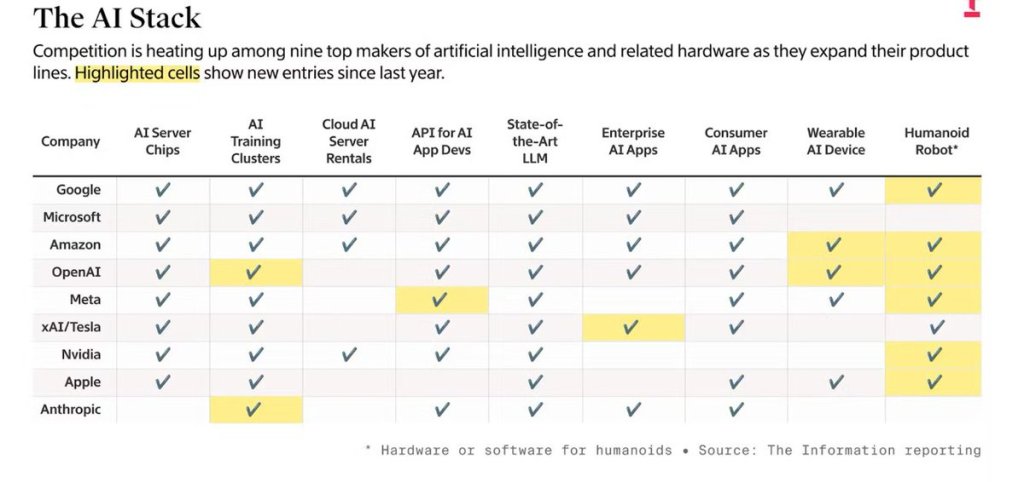


2025 shapes up as the pivotal year where AI powerhouses dive deep into humanoid robots, all while scrambling to control the entire stack–chips, models, devices.
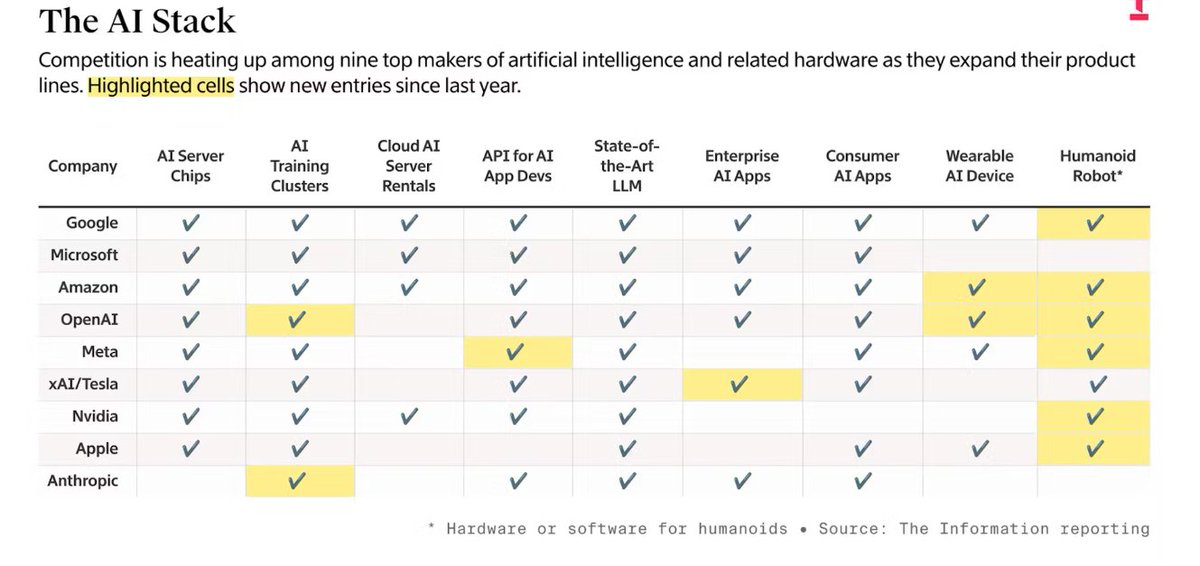
You look at Google beefing up its edge with TPUs and the upcoming Gemini 3, Meta pushing AI glasses, xAI rising quick, and then the web of deals from OpenAI, Microsoft, Amazon tying everything tight. It’s competitive, sure, but also weirdly collaborative, redefining work, creativity, human-machine vibes. Drifted to imagining daily life with these bots, then snap back–the graph from The Information highlights Google’s sprawl, a real quirk in its breadth.
Replies echo this: one notes Google’s ‘AI for everything’ status, poking at ChatGPT’s image tools lagging behind some fictional Nano Banana Pro. Another dreams of billionaires grabbing nanomachines. Praise for Google and Amazon fostering innovation through their scale, leading to parallel, sequential tweaks.
The shift’s from models to full-stack dominance, with Google’s integration giving it vertical control–a decisive pivot. Don’t forget Elon’s Neuralink for brain-linked wearables, or his broader empire covering talent, data, space, manufacturing, energy. Humanoids might just be the hook, the real bottlenecks in silicon, data, distribution to billions.
Advantage now in coupling layers tightly, not isolated leads. This race fascinates, intense and broad-reaching. Yet, a reply warns it’s bad for those not at the top–a sobering jolt. Still, the ecosystem’s interdependence could spark neat improvements ahead.

 Robot Central
Leave a comment