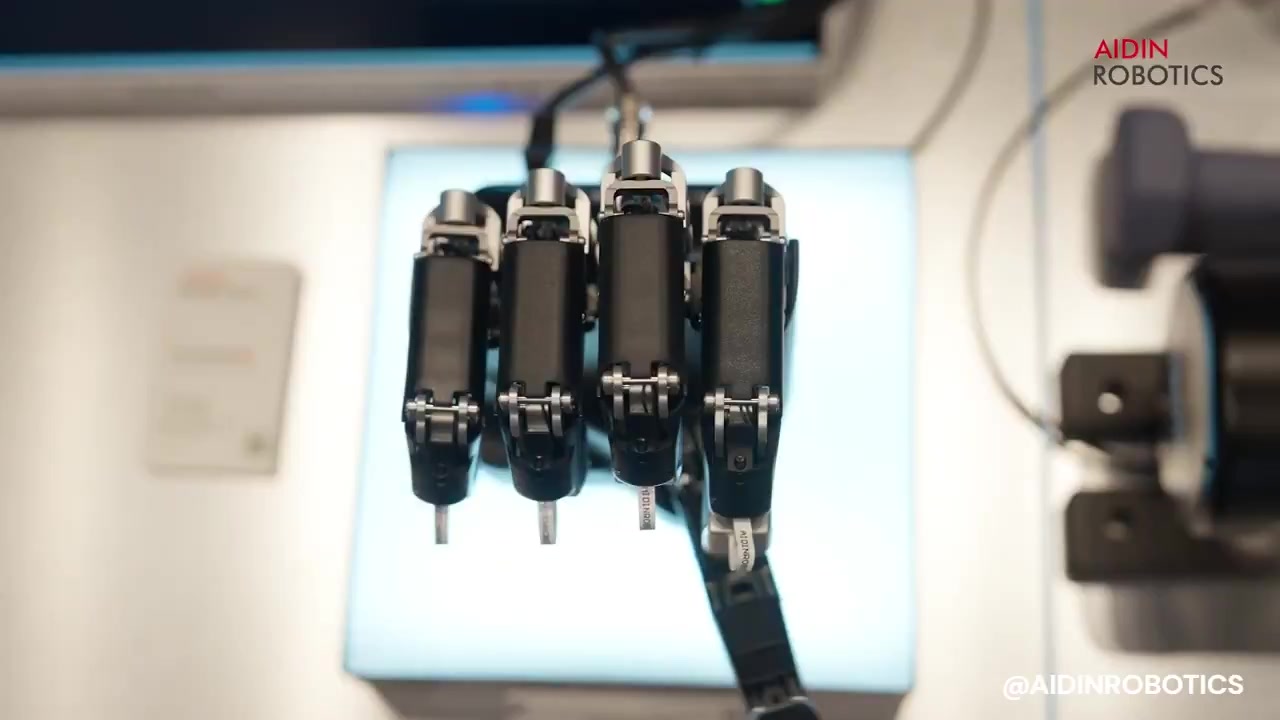
Aidin Robotics from South Korea has introduced the AIDIN-Hand, a compact humanoid robotic hand equipped with 6-axis force and torque sensors built into each fingertip.1 This design allows the hand to adapt to objects of various shapes and sizes, including round and smooth ones, moving beyond scripted motions toward true dexterity in unstructured environments.2 The technology evokes memories of early innovations like the Sega PowerGlove from the 1990s, which enthusiasts hacked for custom control, though today’s version brings industrial precision.
Company Origins and Expertise
Aidin Robotics originated from the Robotics Innovation Laboratory in Sungkyunkwan University’s Mechanical Engineering Department.6 Established in 2019, the company builds on capacitance-type force/torque sensing technology developed since 1995.6 In 2020, it was recognized in Gyeonggi-do’s robotics support program, focusing now on AI-driven sensors, cobot solutions, and no-code automation.
The firm specializes in advanced F/T sensors, tactile sensors, and robot hands for humanoids and cobots.5 This background positions Aidin to address key challenges in precise manipulation.
Design and Key Features
The AIDIN-Hand matches human hand size, remaining compact and lightweight for research applications.1 It integrates self-developed 6-axis F/T sensors in each fingertip, with all actuators and electronics housed in the palm.2 This supports power grips, three-point grips, and pinch grips effectively.
Five AFT-Mini sensors enable unified control of suction and gripping, optimizing handling.6 Such grippers represent progress over rigid tools, offering adaptability like dexterous hands explored in recent developments.
Technical Sensing Capabilities
The fingertip sensors measure forces and torques in 3D space, vital for delicate tasks.1 This force feedback prevents damage to fragile items during manipulation.5 Future iterations plan sensors across fingertips, joints, and palm for comprehensive tactile sensing akin to human hands.2
Demonstrations and Performance
Videos show teleoperation via a glove, using imitation learning to mimic human motions with force feedback.2 The hand grips diverse objects reliably, achieving 600 pieces per hour in picking, up to 5kg and 160mm size.6 Operators gain better control through real-time sensing.
Similar to other advanced designs such as Robotera’s XHAND1, it handles eggs or smooth surfaces without slippage.
Applications in Logistics and Beyond
Aidin’s hand targets tasks beyond conventional grippers, like varying shapes in logistics.1 It forms part of the ‘K-Humanoid Alliance’ with CJ Logistics, KETI, and Sungkyunkwan University for humanoid deployment by 2028.4 This enhances AI humanoid commercialization.
Paths Forward / Looking Ahead
Aidin plans a proprietary teleoperation glove release alongside expanded tactile sensing on joints and palms.2 The national project allocates 5.1 billion KRW, with 4.1 billion government-funded, through 2028 for logistics sites.4 These steps address dexterity gaps in automation, enabling robots to tackle real-world variability without constant reprogramming. Steady investment signals commitment to practical deployment over prototypes.
Broader adoption hinges on integrating such hands with full humanoids for end-to-end tasks. Cost reductions and software maturity will determine scalability in warehouses or cobot lines. Ultimately, fingertip sensing like Aidin’s could standardize adaptive manipulation across the industry, reducing reliance on specialized end-effectors. This evolution prioritizes reliability in unstructured settings.
Leave a Reply