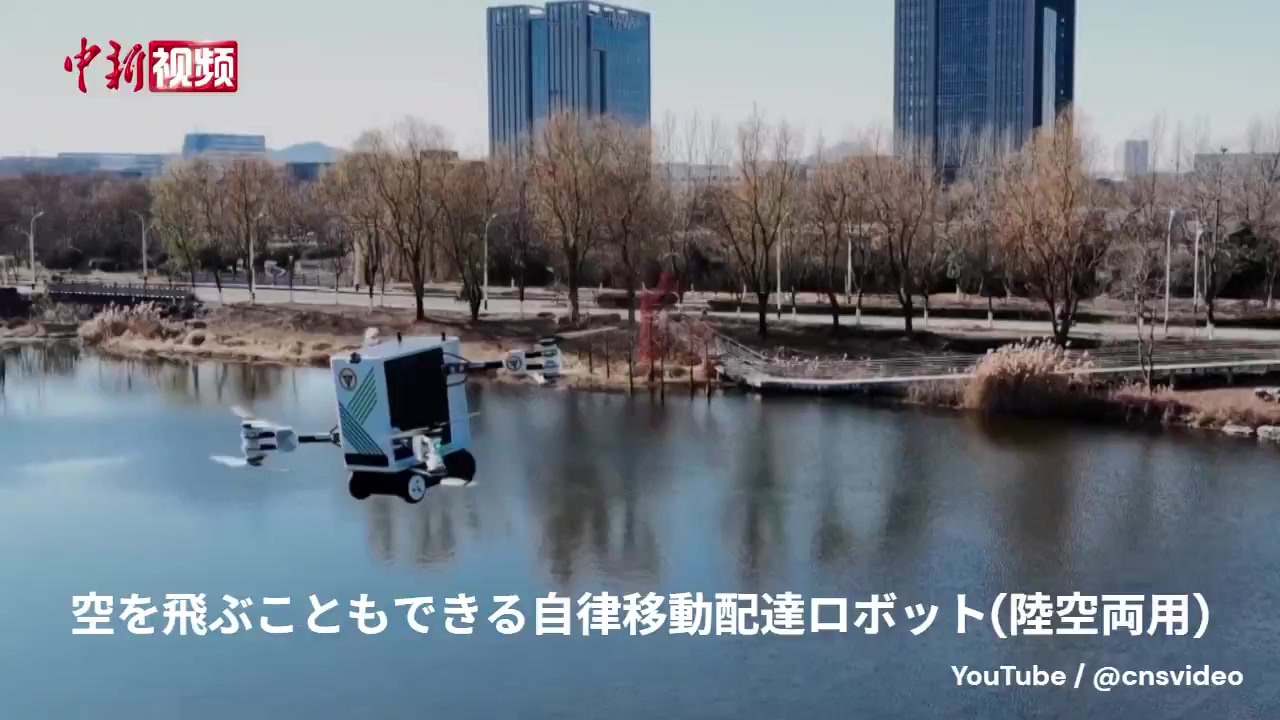
A recent X post highlighted the Dongda Kunpeng, an air-ground dual-use autonomous delivery robot designed for logistics, inspections, and emergency responses.1 This innovation expands beyond traditional delivery by enabling movement on land and in the air, embodying the idea of operating by land, sea, or air through rain, sleet, or snow. Such multi-modal systems like Caltech’s M4 represent a key trend in robotics where drones and ground vehicles merge capabilities.1
Background on Development
Caltech’s Center for Autonomous Systems and Technologies leads research into these systems.1 Teams collaborate on projects that allow robots to switch between ground and aerial modes seamlessly. The Dongda Kunpeng fits into this broader push toward versatile mobility solutions.
The M4, or Multi-Modal Mobility Morphobot, exemplifies this approach with its transformable design.1
Product Features and Technical Details
M4 switches between wheeled ground movement, walking, and flight modes autonomously.1 It uses algorithms to select the best mode based on the environment. Cameras and sensors provide monitoring during all operations.
The mechanical system enables these transformations, supporting navigation in complex terrain.1 Wireless communication links ground and aerial functions for coordinated work. This setup gathers data effectively from different vantage points.
Demonstrations of Capabilities
In tests, M4 worked with a Unitree G1 humanoid robot for joint exploration.1 The humanoid handled indoor tasks while M4 switched to flight for outdoor surveillance. Autonomous mode changes allowed elevated monitoring without intervention.
These demos showed efficiency in disaster-like settings with uncertain conditions.1 The dual setup proved complementary roles in space and air coordination. Such performances highlight practical potential.
Applications and Broader Impact
Beyond delivery, these robots suit disaster response and inspections in hard-to-reach areas.1 Logistics improve with mode-switching for better routes. Humanoids manage indoor work as flying units scout from above.
The design overcomes limits of fixed-mode robots in varied environments.1 Industry strategies align with air-ground dual-use for logistics expansion.2 This versatility addresses real-world challenges effectively.
Comparisons to Existing Solutions
Unlike ground-only bots like RICE or Starship, M4 adds flight.13 Drone-only systems lack ground navigation that M4 provides in one platform. This hybrid stands out against single-mode competitors.
Paths Forward / Looking Ahead
Developers plan multi-robot networks for simultaneous collaboration.1 Advancements target complex indoor and outdoor operations with better decision-making. Enhanced mode selection will handle diverse conditions more reliably, building on current demos.
Future systems promise greater autonomy in emergencies and logistics. Coordinating more than two robots could scale applications significantly. These steps position air-ground dual-use robots as essential tools in robotics evolution.
Related Articles
- Meituan’s Bumblebee Robots Bring Autonomous Food Delivery to Shenzhen Airport Gates
- No Terrain Can Stop the XSTO A6 Robot
- LimX Dynamics Launches COSA: Cognitive OS Enabling Autonomous Humanoid Task Prioritization
Sources for this article
- Supports facts on M4 multi-modal robot design, transformation capabilities, demonstrations with humanoid robots, autonomous mode-selection, sensor integration, and future development plans
- Provides context on air-ground dual-use robot strategies and industry development direction
- Supports information on autonomous ground delivery robot specifications and capabilities for comparison
- Provides autonomous indoor delivery robot technical specifications for comparative context
- Supports information on autonomous ground-based delivery robot systems and capabilities
- Provides background on autonomous delivery robot technology and safety considerations
Leave a Reply