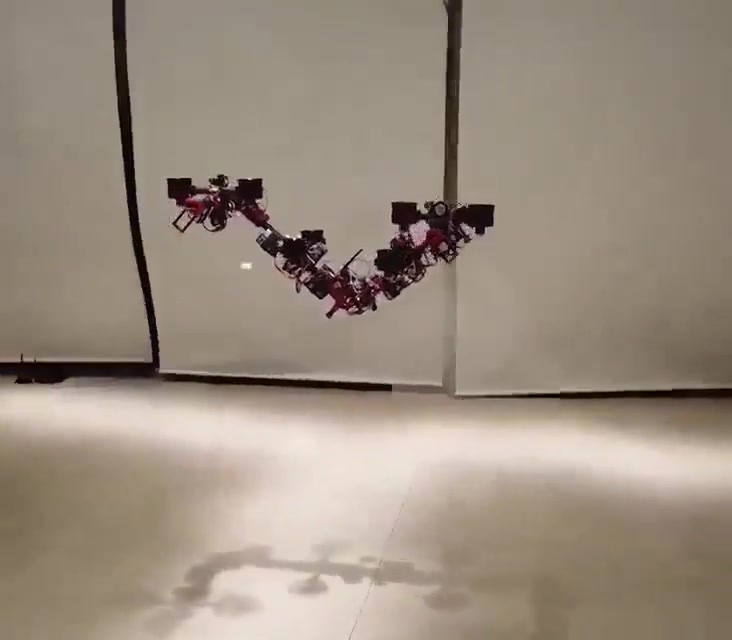
Researchers at the University of Tokyo’s JSK Lab have developed an innovative aerial robot called DRAGON, which stands for Dual-rotor embedded multilink Robot with the Ability of multi-deGree-of-freedom aerial transformatiON. This drone isn’t rigid like traditional models; it’s composed of four articulated segments connected by joints, each featuring two ducted rotors for propulsion and control.
What sets DRAGON apart is its ability to transform its shape while airborne. It can extend, contract, bend, and twist, allowing it to maneuver through narrow spaces that would be impossible for fixed-frame drones. For instance, it can squeeze through gaps smaller than its fully extended diameter by reconfiguring into a more compact form.
The robot’s design draws inspiration from serpentine creatures, enabling versatile movements. Each module is powered by batteries and controlled via an onboard computer, with thrust vectoring for precise adjustments. Demonstrations show it flying, grasping objects, and even perching.
Potential applications include search and rescue in disaster zones, infrastructure inspection in confined areas, and environmental monitoring. While still a prototype, DRAGON represents a leap in adaptive robotics, pushing boundaries beyond conventional drone limitations. Future iterations may incorporate more segments for enhanced flexibility.
Leave a Reply