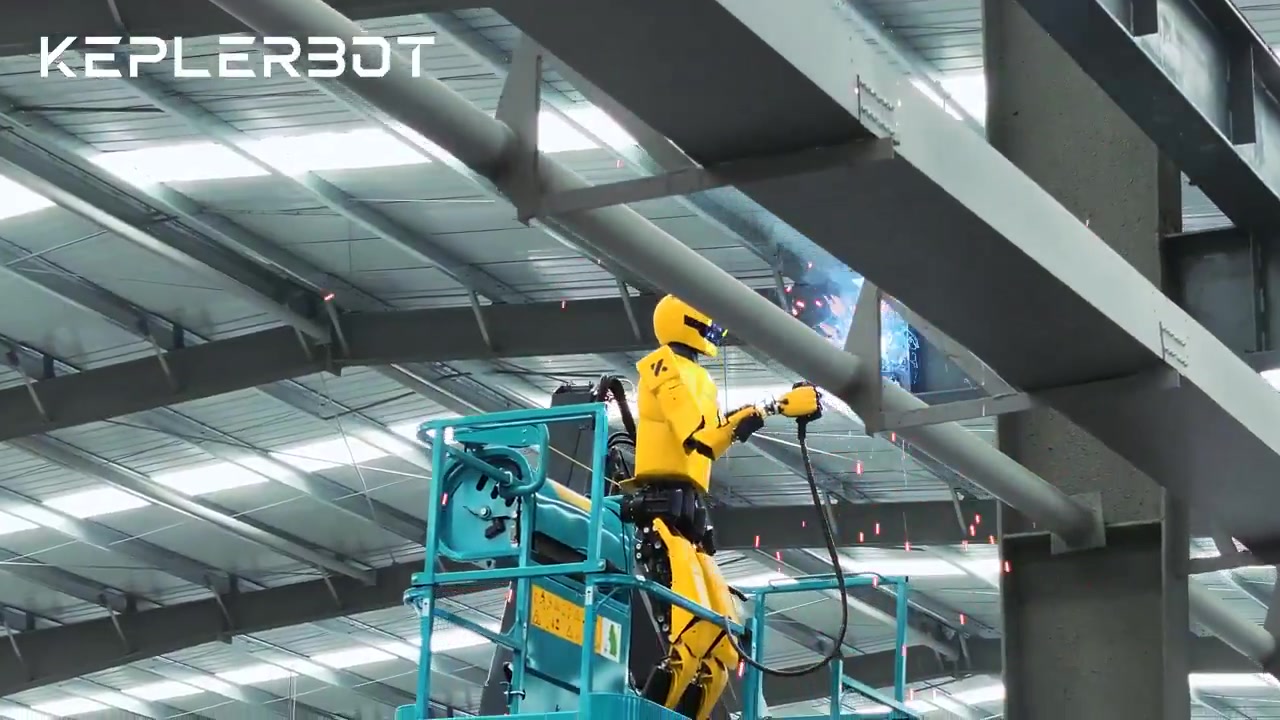
A yellow humanoid robot stands on a work platform under the roof beams of a factory hall, a welding torch in its hand and sparks spraying off the steel.1 Down on the floor, a man in a black T-shirt wears a VR headset and holds two handheld controllers, and when he moves, the robot moves with him.12 The clip comes from Shanghai-based Kepler Robotics, and it reached a wide audience in January 2026 when the account CyberRobo (@CyberRobooo) posted it, saying a human in a VR headset “remotely controlled K2 to replace manual high-altitude dangerous work.” That post drew about 28,300 impressions, 435 likes and 102 bookmarks.3
It is a striking picture, and an easy one to misread. The robot is not deciding where to weld. A person is driving it, the way a pilot flies a drone, and the robot copies the operator’s motions one to one.4 We wanted to sort out what this demo proves, what it does not, and why remote-controlled humanoids may reach dangerous jobs well before fully autonomous ones do.
Video: Kepler Robotics’ K2 “Bumblebee” welding from a work platform while an operator on the ground controls it with a VR headset, from the company’s January 2026 video on X. Company promotional footage, letterboxed to fit. Audio muted.
What the Video Shows
Kepler’s own post on X went up about eight hours before CyberRobo’s and calls the job the “world’s first human-robot collaborative high-altitude welding,” powered by “immersive full-body VR teleoperation.”1 The 77-second company video opens with an operator carrying in a case, putting on a headset and raising his hands while the robot mirrors him, then cuts to the robot on a lift welding steel beams.1 CyberRobo’s shorter 54-second version carries a Chinese “KEPLER” watermark and adds a heads-up display shot with on-screen readouts of 180A and 24V.3
A Chinese-language launch story published by the tech site ZOL and syndicated by Sina Finance on January 16, 2026, says the job took place at a Luxiao Technology factory, with the robot working 20 meters up for eight continuous hours.4 It credits a teleoperation system that combines motion capture, low-latency networking and force feedback, with a delay of 100 milliseconds or less and motion reproduction accurate to 0.1 mm.4 Those are company figures, not independent measurements, and the footage alone does not let a viewer judge the 20-meter height.
“High-Altitude” Means Work at Height
If “high-altitude welding” makes you picture a mountaintop, blame translation. The Chinese phrase behind it describes ordinary work at height, on lifts, scaffolds and steel frames, and the robot in this demo welds from an elevated work platform.42 That is where welding gets most dangerous, because a worker managing a torch, heat and fumes on a lift or scaffold also faces the risk of a fall.2
The numbers behind that worry are stark. In the United States in 2023, falls, slips and trips caused 38.5 percent of construction deaths, and construction accounted for 47.8 percent of all fatal falls, slips and trips across industries.5 The ZOL report claims more than a thousand casualty accidents a year in China from welding and other work at height, a figure it attributes only to unnamed data.4 Meanwhile, the American Welding Society has projected that the U.S. will need more than 330,000 welders by 2028.6
Who Makes the K2?
Kepler says it is “dedicated to developing industry-leading, blue-collar humanoid systems.”7 The K2, nicknamed “Bumblebee,” is 175 cm tall, weighs 75 kg and has 52 degrees of freedom, 11-degree-of-freedom hands with 25 touch points per finger, and 100 TOPS of onboard computing.87 It can carry up to 30 kg with both arms and, according to the company, runs eight hours on a one-hour charge.8
Kepler announced mass production in September 2025 at a list price of RMB 248,000 per unit and said it had framework agreements covering several thousand units.9 Earlier in 2025 it had quoted a base price of $30,000.7 The company openly says the K2 is “powered by Tesla’s hybrid architecture,” and the Bumblebee name echoes an early prototype of Tesla’s Optimus.10 Its joints pair planetary roller screw linear actuators with rotary motors, and Kepler’s mass-production release claims up to 81.3 percent energy efficiency for the hybrid architecture.9
Teleoperation Is Not Autonomy
Here is the key distinction. Teleoperation means a human controls a robot remotely in real time, seeing through its cameras and moving its limbs through controllers or a motion-capture rig. Autonomy means the robot decides and acts on its own. In Kepler’s demo, the welding skill belongs to the person on the ground, and the robot is a strong body that stands in the heat, smoke and fall risk in place of theirs.4
The industry has been burned by blurring the two: at Tesla’s “We, Robot” event in October 2024, Optimus robots served drinks and chatted with guests, and reporting later confirmed that humans were remotely operating many of those interactions.11 One bartender robot told a guest, “Today, I’m assisted by a human. I’m not yet fully autonomous.”12 Kepler, to its credit, puts the human in the headline by calling the job “human-robot collaborative.”1
Teleoperation is also how many companies plan to teach robots, which is why tools like data gloves that capture every finger movement keep showing up in humanoid labs. 1X has said remote operators will handle complex chores on its NEO home humanoid at first, so the company can gather training data, and CEO Bernt Børnich said, “If we don’t have your data, we can’t make the product better.”13 Kepler makes the same pitch: its system records force, path and load data during each job, and it claims the robot can adapt to a new workpiece’s tolerances after three to five teleoperated demonstrations.414
Remote-Controlled Humanoids Already Have Jobs
Humanoid-shaped robots working at height under remote control are not hypothetical. Since July 2024, West Japan Railway (JR West) has used a giant two-armed robot from Jinki Ittai and Nippon Signal, mounted on a boom on a road-rail vehicle, to paint overhead-line supports and cut back trees.15 The operator sits in a cab on the vehicle and sees through the robot’s head cameras with VR goggles, and the machine can grip up to 40 kg and work 12 meters up.15
JR West’s stated goal is to cut the risk of falls and electric shock, and Railway Gazette reported it expects to reduce the workers needed for many tasks by around 30 percent.1516 CyberRobo itself pointed to this robot in a follow-up post as “another use case for remotely operating humanoid robots for working at heights.”17 Tellingly, a JR West engineer told ITmedia the team never set out to build a humanoid; two arms and a camera head simply turned out to be the best fit for the job and the cost.18
What Is Real and What Is Still Demo
Real: the K2 is a product with published specs and a price, Kepler says dozens of K2s work daily at a Chunmi Technology factory, and keeping a human operator in the loop is a proven pattern for dangerous work.91415 Unverified: the 20-meter height, the eight hours without a hitch, the sub-100-millisecond delay and the 0.1 mm accuracy all come from Kepler’s own materials, and we found no independent test or published weld inspection.414 Even the “first” is fuzzy, since Kepler’s English post says “world’s first” while the Chinese report and a Pudong government news item say China’s first.1419
There are practical questions too. A teleoperated robot still needs a skilled welder at the controls, so it moves the human out of danger rather than out of the job.4 Kepler claims teleoperation over distances of up to 2,000 km, which would let one expert serve faraway sites, but its own list of safeguards includes handling network loss and power cuts, a reminder that the link itself is a point of failure.4
In April 2026, Kepler recast the K2 as a robot for live-line electrical work and pitched it at China’s State Grid, which Kepler’s release says plans to buy 500 humanoid live-line robots.14 That points to where Kepler sees paying customers: substations, towers and other places where human work is risky.14 Safety cuts both ways with remote humanoids, as our story about a teleoperator who got kicked by his own robot showed.
What the Replies Said
Most replies under CyberRobo’s post cheered the safety angle, with IIoT World calling VR welding “a smart way to keep people out of harm’s way.”20 The sharpest skeptic, @EdwadSouth, said he would not trust the weld as structural, calling it a “cool use case” with “bad execution.”21 We cannot grade a weld from a video either, which is exactly why published inspection results would matter.
@warrior_bucket asked what is new compared with ordinary remote operation.22 Kepler’s answer is full-body control with force feedback and a body that can hold a 30 kg load, where older industrial teleoperation often covered only the upper body.4 CyberRobo listed underwater work, high-voltage stations and equipment-room inspections as natural fits.23 PrismaX saw a training angle, “Teleoperating welding is a good idea to train robots for the same,” and @TheUnfilteredOz predicted the robots will “keep learning from us until eventually they’re able to do it themselves.”2425
Some later posts overshot. One August 2026 post said the K2 had been “approved for welding at heights” and priced it at $20,000 to $30,000, but we found no approval or certification in Kepler’s materials, and the company’s list price is RMB 248,000.269 A Korean-language quote post put it more carefully: still at the demonstration stage, but if commercialized, people would no longer need to do dangerous work in dangerous places.27 Even CyberRobo, re-sharing the clip in November 2026, labeled it “demo.”28
Looking Ahead
The near future of humanoids in dangerous work probably looks a lot like this demo: a person in a safe spot, a robot body in the hazard, and a data log of every move.4 If Kepler’s three-to-five-demonstration claim holds up outside a showcase, the human role could shrink from driving every motion to supervising and correcting.14 Our read is that the test that matters is a boring one: third-party weld inspections and uptime numbers from a paying customer.
For now, the honest label is “human-robot collaboration,” which is what Kepler wrote.1 The skilled welder is still essential, and the difference is that the welder can stay on the ground. That alone could make a dangerous trade safer and keep experienced people working longer, as veteran JR West crews told ITmedia about their own robot.18
Related Articles
- Embracing Humanoid Robots: Lessons from a Teleoperator's Kick and Asimov's Legacy
- MANUS Data Gloves Capture Every Finger Movement
- Tesla's Optimus: The Robot Poised to Dominate the Global Workforce
- Humanoid Robots Advance in Manufacturing: From Excavators to Potential Self-Replication
- DEEP Robotics' Lynx M20 at -30°C and the Jobs the Cold Unlocks
Sources for this article
- Kepler Robotics (@BotKepler) on X: World’s first human-robot collaborative high-altitude welding is here (Jan 14, 2026 ET, video)
- India Today, Watch: Kepler’s Bumblebee robot does welding like an industrial welder (May 12, 2026)
- CyberRobo (@CyberRobooo) on X: Shanghai Kepler’s humanoid robot K2 demonstrated high-altitude welding (Jan 15, 2026)
- ZOL via Sina Finance, Kepler’s first “human-robot collaborative” high-altitude welding operation (Jan 16, 2026, in Chinese)
- U.S. Bureau of Labor Statistics, Fatal falls in the construction industry in 2023 (May 9, 2025)
- American Welding Society, Discover the Future of Welding: The Careers in Welding Mobile Experience Is in Town (July 2024)
- The Robot Report, Kepler Robotics showcases K2 ‘Bumblebee’ humanoid at ICRA 2025 (June 5, 2025)
- Kepler Robotics, Forerunner K2 product page (official site)
- Kepler Robotics via PR Newswire, K2 “Bumblebee” moves into mass production (Sept 26, 2025)
- Humanoids Daily, Kepler Announces Mass Production of ‘Bumblebee’ Humanoid, Embracing Tesla Similarities (Sept 2025)
- TechCrunch, Tesla Optimus bots were controlled by humans during the ‘We, Robot’ event (Oct 14, 2024)
- Ars Technica, Reports: Tesla’s prototype Optimus robots were controlled by humans (Oct 15, 2024)
- Engadget, 1X Neo is a $20,000 home robot that will learn chores via teleoperation (Oct 29, 2025)
- Shanghai Kepler Robotics via PR Newswire Asia, K2 Bumblebee completes live-line welding at 20 meters (Apr 30, 2026, in Chinese)
- Jinki Ittai via PR TIMES, humanoid heavy machine enters JR West railway maintenance (July 17, 2024, in Japanese)
- Railway Gazette International, Humanoid robot to maintain Japanese railway infrastructure (July 9, 2024)
- CyberRobo (@CyberRobooo) on X: Another use case for remotely operating humanoid robots for working at heights (Jan 16, 2026)
- ITmedia Business Online, Why a humanoid robot? JR West on its railway maintenance labor shortage, page 2 (Aug 15, 2024, in Japanese)
- Pudong government news via China Daily, Pudong robotic firms accelerate industry innovation (Jan 22, 2026)
- Reply by @IIoT_World: VR teleoperation for high-altitude welding keeps people out of harm’s way
- Reply by @EdwadSouth: would not trust that weld as structural
- Reply by @warrior_bucket: what is new compared with ordinary remote operation?
- Reply by @CyberRobooo on remote operation for underwater work, high-voltage stations and equipment rooms
- Reply by @PrismaXai: teleoperating welding is a good idea to train robots
- Reply by @TheUnfilteredOz: they will keep learning from us
- Post by @Yura_5800 claiming the K2 was approved for welding at heights (Aug 19, 2026)
- Quote post by @mad20130301: still at the demonstration stage (Jan 29, 2026, in Korean)
- CyberRobo (@CyberRobooo) on X: re-share of the K2 welding clip labeled “demo” (Nov 7, 2026)
Leave a Reply