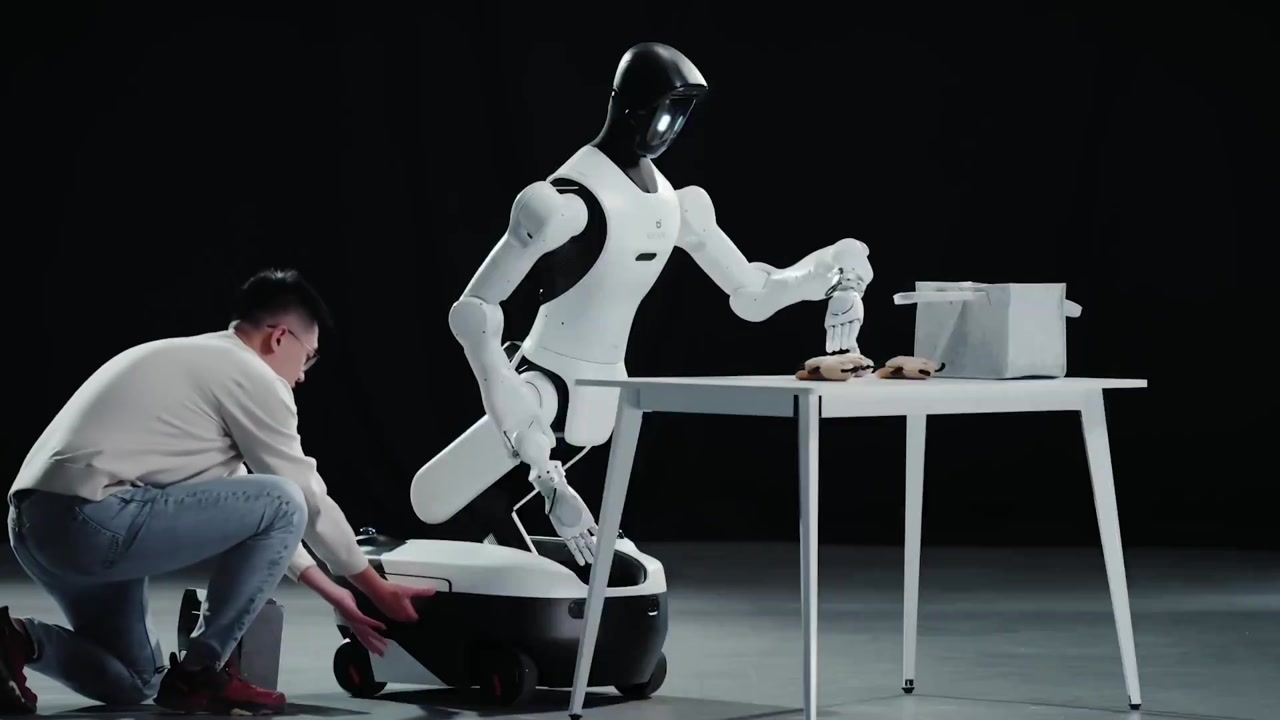
A white robot with a dark visor for a face bends at the knees over a table, placing items into a fabric bin, while a technician kneels beside it and swaps a battery out of its base.1 It has two arms, a torso, a head and folding legs, but no feet. Its legs end in a low base that rides on four steerable wheels.12 This is AGIBOT’s Genie G2, and a clip of it reached a new audience in January 2026 when the tech influencer Ronald van Loon (@Ronald_vanLoon) shared it as “AGIBOT Unveils Genie G2: Next-Generation Wheeled Humanoid,” crediting CyberRobo (@CyberRobooo).3
That post drew about 9,800 impressions and 252 likes, and the same clip and caption had appeared on his account at least three times before, starting in October 2025.34 The robot is not new, but the question it raises keeps coming back: if a humanoid works indoors, does it need legs at all? We looked at what AGIBOT built, what it claims, and why so many builders are putting humanoids on wheels.
Video: AGIBOT’s Genie G2 wheeled humanoid on test benches, in a warehouse aisle and in durability tests, from the company’s February 2026 product video on X. Company promotional footage, scaled to 1280×720. Audio muted.
What the Video Shows
The clip that keeps circulating is a polished, Chinese-captioned launch film. CyberRobo posted it on launch day in China (late on October 15, 2025, U.S. Eastern time), describing a wheeled humanoid built for “handling, precision manipulation, and inspection,” with 19-degree-of-freedom hands and 360-degree navigation.5 The same film also shows the robot doing security, guest reception and household chores, which CyberRobo described as service capabilities.5
The video at the top of this page is AGIBOT’s own English product film, posted in February 2026. It shows the G2 on test benches, in a warehouse aisle and in heat, cold and endurance tests, with captions naming each feature.1 Both are company promotional videos that show what AGIBOT wants buyers to see, not an independent field test.
What AGIBOT Built
AGIBOT, known in Chinese as Zhiyuan, launched the G2 on October 16, 2025, together with PIA Automation in Ningbo, calling it the robot’s first in-person appearance and saying the first units had already been delivered to customers.67 The company pitches it as an “industrial-grade interactive embodied robot” for factory work, logistics and guided tours.8 “We envision Agibot G2 relieving humans from repetitive, labor-intensive, and safety-risk prone work,” said Yao Maoqing, who runs AGIBOT’s embodied business unit.8
On paper, the G2 stands between 1.225 and 1.795 meters tall, because its body rises and lowers, and it weighs 185 kg.9 It has 26 actively driven joints: three in the neck, seven in each arm, five in the waist and legs and four in the chassis.9 Each arm is rated for 5 kg, the base tops out at 1.5 meters per second, and two batteries totaling 1,652 watt-hours give about four hours of running time.9 The launch release adds an NVIDIA Jetson Thor computer and hot-swappable batteries with self-charging for round-the-clock shifts.8
Those are AGIBOT’s figures, and they do not always line up. Chinese launch coverage described a body with 50 degrees of freedom, a higher count that appears to include the hands, while the spec sheet lists 26 not counting the hands.69 The company also says the G2 passed more than 130 component tests, works from -15 to 50 degrees Celsius and can navigate more than 95 percent of factory floors.8 We found no independent test of those claims.
Wheels vs. Legs, Indoors
A factory floor is flat, smooth and mapped, which is most of the case for wheels. IEEE Spectrum noted in 2025 that demo videos mostly show legged humanoids standing still or walking short distances over flat floors, and argued that robots with arms on wheels are a “more reliable, efficient, and cost-effective” option for now.10 Rolling is also cheaper in energy than stepping, which is why researchers have added powered wheels even to four-legged robots.11
“I thought about legs for 20 years; that’s the class I teach at MIT,” Walden Robotics CEO Russ Tedrake told IEEE Spectrum, explaining why his company chose wheels. “But the question is, what’s the addressable market? And what percentage of it is covered by a wheeled base?”12 Tedrake added that a big wheeled base invites you to pack it with batteries, and the extra weight low to the ground keeps the robot steady.12
In January 2026, Brian Heater of the A3 trade group wrote that estimates he hears for how much factory and warehouse work wheels can handle often land around 80 percent, and that Amazon alone runs more than a million wheeled mobile robots in U.S. fulfillment centers.13 The London startup Humanoid, which builds both versions, told him its industrial work for the next five years will run almost entirely on wheeled bases. “We are concentrating on the wheel platform because it can provide the first revenue as soon as possible,” said strategy chief Alina Kolpakova.13
Legs still win in some places. Stairs exist, and a legged robot takes up less floor space than a wide wheeled base.12 The G2 shows the limits plainly in its own manual, which tells owners to run it on flat floors, keep slopes at 5 percent or less and expect it to climb obstacles no taller than 3 cm.2
Why Falling Matters
The biggest argument for wheels may be safety. A walking robot stays upright only because its motors keep balancing it, so the usual industrial fix of cutting the power can make a two-legged robot fall over.10 An ISO committee is drafting a safety standard, ISO 25785-1, for robots that need active control to stay balanced and “could become unstable in the absence of power.”14 It is still under development.14
A robot on a four-wheeled base does not have that problem when it stops. “Factories already have autonomous mobile [wheeled] robots,” Tedrake said, and they “already have safety cases built around AMRs.”12 The G2’s chassis steers all four wheels, so it can turn like a car, slide sideways or spin in place.29
Why Hybrid Makes Sense
The G2 is not just an upper body bolted to a cart. Its waist and legs bend, so it can raise or lower its body by more than half a meter to reach low bins or higher shelves, while the wheels do the traveling.91 That is the hybrid idea: borrow the human shape where reach and posture matter, and use wheels where moving around matters. We saw a four-legged version of the same logic in DEEP Robotics’ wheel-legged Lynx M20.
Even Boston Dynamics is experimenting. In November 2026 it swapped its Atlas humanoid’s feet for off-the-shelf scooter rims, mounted on the ankle motors with a single custom adapter part.15 The company was clear that “a wheeled Atlas isn’t a product. It’s a research testbed” for pushing its motors and control software.15
From Demo to Factory Floor
Days before the launch, the electronics manufacturer Longcheer placed a framework order worth hundreds of millions of yuan for G2 robots, with nearly 1,000 units planned for its factories, one of the largest industrial humanoid orders in China.16 A framework order sets terms for future purchases. It is not the same as delivered robots.
In April 2026, AGIBOT said several G2s were working on Longcheer’s tablet production lines in Nanchang, picking devices, loading them into test fixtures and sorting good units from bad.17 The company claimed up to 310 units per hour, cycle times of about 19 to 20 seconds, a success rate above 99 percent and more than 140 hours of continuous running.17 Longcheer streamed the line for eight hours with Xinhua News Agency, but the performance numbers come from AGIBOT, not an outside audit.1817
A research team from Tsinghua University, AGIBOT and Infinigence AI later trained manipulation skills on a fleet of 96 robots, using dual-arm G2s, and reported success rates of 93.3 to 99.2 percent across five tasks.19 AGIBOT has since added a heavier G2 Max rated for 40 kg across both arms, with a working height from 0.1 to 2.5 meters.20 Scale matters here, too. Market researcher Omdia ranked AGIBOT first in humanoid shipments for 2025 at 5,168 units, or 39 percent of the world total, something we covered when the numbers came out.21
What the Replies Said
The sharpest exchange came under a December 2025 clip, with nearly 24,000 impressions, of a G2 boarding a subway train after a person lays a metal plate across the gap at the door. “That metal plate is key,” the poster wrote.22 PrismaX asked whether that would be “a big hurdle for wheeled robots,” and another user said that if you need a ramp, “you prolly need to upgrade ur bot.”2324 That fits the 3 cm limit in AGIBOT’s own manual.2
Others saw a trend. “I am seeing a shift in the design from bipedal to wheeled robots,” one reply under van Loon’s post said, adding that real deployments would show what these machines can do.25 On a later wheeled-robot thread, one user argued wheels “make a lot of sense on a flat factory floor,” and that legs only earn their keep with “stairs, rugs and toys on the ground.”26 Another pushed back that without legs, a humanoid cannot reach a basement or take the stairs to get the mail.27
One user asked why a wheeled robot needs “a human shaped torso and head” at all.28 The best answer is that workplaces are built around human reach, eye height and two-handed work, which the G2’s rising body and dual arms target, while its head mostly carries sensors and an interaction screen.98 Another asked whether a wheeled base balances itself or stays stable when stopped, and for a four-wheeled base like the G2’s it is the second, the safety point above.2912
Looking Ahead
For factories and warehouses, the near future of humanoids probably rolls. Wheels are cheaper, simpler to make safe and already trusted on the factory floor, and the G2’s order book, Longcheer’s line and Omdia’s shipment ranking all point the same way.10121621 Our read is that the numbers to watch are not demo videos but independent uptime and throughput data from paying customers.
Legs are not going away. Homes, stairs and cluttered spaces still favor robots that can step, and even legged builders are adding wheels to see what the mix can do.2715 The likely result is not wheels versus legs but a choice by job: wheels where the floor is flat, legs where it is not, and hybrids like the G2 in between.
Related Articles
- AGIBOT Leads 2025 Humanoid Robot Shipments with Over 5,100 Units
- DEEP Robotics' Lynx M20 at -30°C and the Jobs the Cold Unlocks
- Tron2 Debuts: LimX Dynamics' Half-Humanoid Robot Redefines Agility and Tasks in Robotics Evolution
- AGIbot X2: From Smooth Strides to Future Realities
- Kepler K2 Welds High Up by VR: Real Job or Robot Demo?
Sources for this article
- AGIBOT (@AGIBOTofficial) on X: AGIBOT G2, The Next Generation of Industrial-Grade Interactive Embodied Operation Robots (Feb 25, 2026 ET, video)
- AGIBOT, AGIBOT G2 User Manual (hosted by RobotShop, PDF)
- Ronald van Loon (@Ronald_vanLoon) on X: AGIBOT Unveils Genie G2: Next-Generation Wheeled Humanoid Robot, by @CyberRobooo (Jan 18, 2026)
- Ronald van Loon (@Ronald_vanLoon) on X: earlier post of the same CyberRobo clip and caption (Oct 24, 2025)
- CyberRobo (@CyberRobooo) on X: AGIBOT has released the next-generation humanoid robot, the Genie G2 (Oct 15, 2025 ET, video)
- Science and Technology Daily, AgiBot and PIA Automation jointly launch the new-generation wheeled robot G2 (Oct 17, 2025, in Chinese)
- AGIBOT (@AGIBOTofficial) on X: AgiBot Launches New-Gen Industrial Interactive Embodied Robot, AgiBot G2 (Oct 16, 2025)
- Agibot via PR Newswire, Agibot Unveils Next-Gen Industrial-Grade Interactive Embodied Robot Agibot G2 (Oct 16, 2025)
- AGIBOT, AGIBOT G2 Specs sheet (2025, hosted by RobotShop, PDF)
- IEEE Spectrum, Evan Ackerman, Humanoid Robots: The Scaling Challenge (Sept 11, 2025)
- IEEE Spectrum, Wheels Are Better Than Feet for Legged Robots (ANYmal hybrid rolling and walking)
- IEEE Spectrum, Evan Ackerman, Why Walden’s Humanoid Robots Run on Wheels, Not Hype (Aug 3, 2026)
- A3 (Association for Advancing Automation), Brian Heater, Work, Life, Balance: How Humanoid is Approaching the Market (Jan 22, 2026)
- ISO/CD 25785-1, Robotics: Safety requirements for dynamically stable industrial mobile robots (legged, wheeled, or other forms of locomotion), Part 1 (committee draft, under development)
- The Robot Report, Boston Dynamics adds wheels to Atlas humanoid to test whole-body control (Nov 9, 2026)
- China Daily, China’s startup ramps up application of humanoid robots (Oct 12, 2025)
- AGIBOT, AGIBOT and Longcheer Technology Achieve World’s First Embodied AI Deployment in Consumer Electronics Precision Manufacturing Mass-Production Line (Apr 14, 2026)
- Longcheer Technology, live broadcast of the humanoid robot production line at its Nanchang factory (Apr 2026)
- Chao Yu et al. (Tsinghua University, AgiBot, Infinigence AI), Learning from Fleet Experience: Collective Experience Learning Across 96 Robots, arXiv 2610.25736 (Oct 2026)
- AGIBOT, AI WAVE: AGIBOT releases the safety-rated heavy-duty embodied robot G2 Max (Oct 26, 2026, in Chinese)
- TechNode, China’s AgiBot leads global humanoid robot shipments in 2025, Omdia says (Jan 9, 2026)
- Tuo Liu (@Robo_Tuo) on X: This is how a wheeled humanoid (AgiBot G2) gets into the subway (Dec 15, 2025, video)
- Reply by @PrismaXai: Will this be considered a big hurdle for wheeled robots?
- Reply by @3duserinterface: if you have to manually use a ramp, upgrade the bot
- Reply by @chynaqqq: a shift in design from bipedal to wheeled robots
- Reply by @QAS_LLC: wheels make sense on a flat factory floor; legs earn their keep with stairs, rugs and toys
- Reply by @cain151714: no legs are a big limitation for humanoids (stairs)
- Reply by @decentralizedX1: why does this type of robot need a human-shaped torso and head?
- Reply by @Yash_KVR: does the base balance actively, or is it stable when stopped?
Leave a Reply