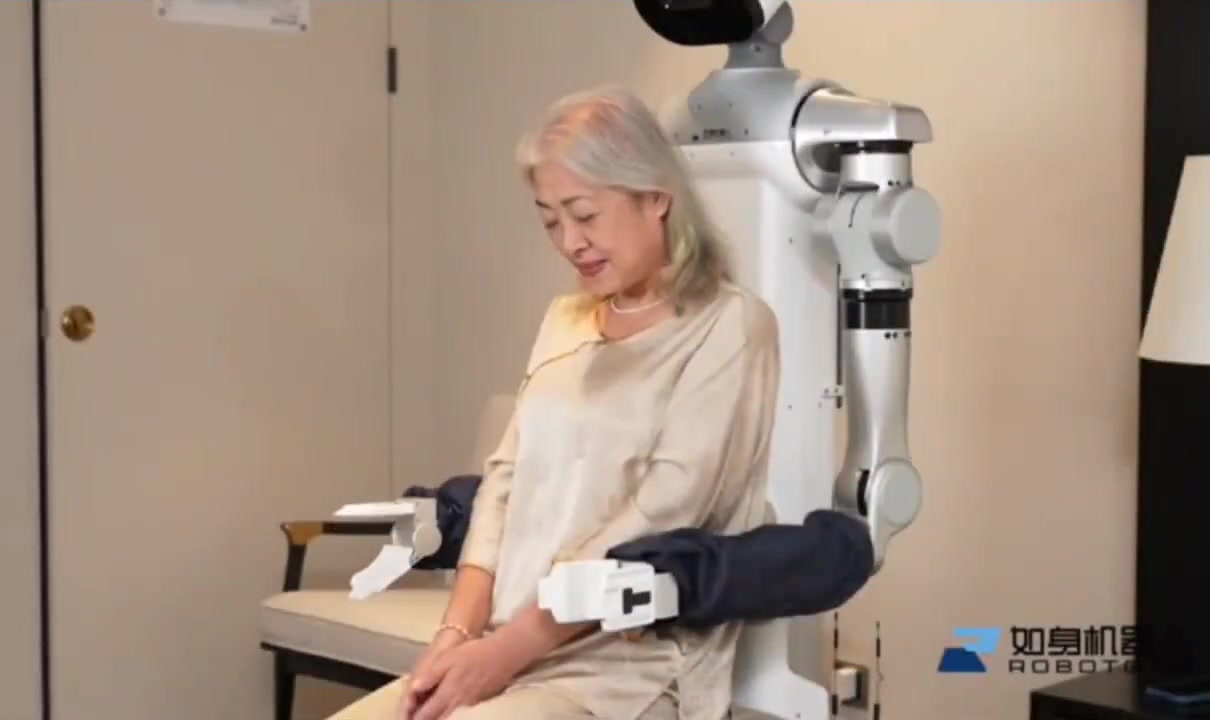
An older woman leans back on her pillows and asks the robot beside her bed, “Xiaoru, what’s the weather like today?” Seconds later the same machine turns its body around and becomes a chair she can ride. When @XueJia24682 shared the clip in January 2026, calling China’s Rushen Robot “your reliable home care buddy,” it drew about 339,000 impressions and 2,200 likes.1
It is a gentle video about a hard problem. China had 323 million people aged 60 or older at the end of 2025, 23 percent of its population,2 and the World Health Organization expects 1 in 6 people worldwide to be 60 or older by 2030.3 So we looked past the clip to what Rushen has actually built, what independent reporting confirms, and what is still a company promise.
Video: Rushen Robot (RobotGym) promotional footage of its Qijia elder-care robot, with Chinese captions, as shared on X by @XueJia24682. The closing card is from Yanglao Zhisheng (养老之声, “Voice of Elder Care”), a Chinese social media account that reposted the clip. It is a company demo, not an independent test.
Who Makes It
The company is Shanghai Rushen Robotics, which sells abroad under the name RobotGym. It was founded in June 2023 to build rehabilitation and elder-care robots.4 It was incubated by MicroPort, the Shanghai medical device group, and sold a rehabilitation robot called Gewu before moving into daily care.5
Founder and CEO Shi Yunlei helped launch a Chinese surgical-robot company that later went public, then did doctoral research in embodied intelligence in the lab of Zhang Jianwei, a member of the German National Academy of Science and Engineering.67 The robot in the video is Rushen’s elder-care machine, called Qijia in Chinese and UniCare on its English product page.8
What the Robot Does
Chinese reports call Qijia a half-humanoid. Its upper body is humanlike, with two arms, and its lower body is a wheelchair base instead of legs.9 In robot mode it helps with feeding, cleaning, fetching things and conversation, and in wheelchair mode it carries a seated person indoors or out.8 Switching modes only means rotating the robot’s body to a new orientation.9
The current English spec sheet lists an 80-kilogram machine with 22 degrees of freedom, arms rated to lift 10 kilograms each and 20 at most, a top speed of 1 meter per second, and about eight hours of operation.8 It finds its way with stereo cameras, lidar and ultrasonic sensors.8
Rushen chose wheels over legs on purpose. “We chose an omnidirectional moving chassis instead of bipedal walking,” the company wrote, so the robot would be stable and “less prone to falls.”6 Its arms use force control precise to about one newton, which matters when the job is lifting a spoon to someone’s mouth.69
Matching the Video to the Record
The clip walks through a day of care with Chinese captions on screen. We read them frame by frame: voice greetings, switching to a passenger mode for transfers, tidying the bed, medication reminders, heating food, feeding, cleaning up spills, games, fall monitoring with an immediate response, and outings.1 Nearly all of those appear on Rushen’s product page, from medication reminders to emergency calling.8
Independent reporting confirms the machine is real and has met real older people. In September 2025, Shanghai’s Civil Affairs Bureau described a half-humanoid about 1.7 meters tall that could help people get up, turn over or walk, feed them, and fetch things, though staff said it was still a prototype being tuned.10 In October 2026 the China Business Journal reported that a Qijia robot nicknamed Xiaoru had joined the team at the Beicai Penghai care home in Shanghai in August, doing safety rounds, reminders, daily help and companionship alongside nurses.5
Rushen told the same paper it delivered its first unit to a private home in June 2026, opened reservations for home users in September, and had logged several thousand hours of real use in care homes and homes by August.5 Those figures come from the company, not an outside audit.
What “Full-Time Care” Really Means
The X caption promises “full-time attentive care.”1 Rushen’s own description is more careful. Because today’s robot AI cannot yet handle every real-world task, Qijia runs in a “dual-mode parallel” setup: AI agents handle most interaction, while tasks beyond them “are completed by professional nurses through a remote operation platform.”6
Those remote nurses use what the company calls bilateral force feedback, so they can feel how hard the robot presses on a cup or a shoulder.6 The English product page advertises a 24/7 remote collaboration platform with emergency response in seconds.8 In other words, the round-the-clock part depends on people, too.
The company is also frank about limits. It told the China Business Journal that high-risk tasks such as turning someone in bed or moving them from bed to chair still need professional assessment and human help, and that its current trials focus on fetching items, mobility help and companionship.5 In a 2025 interview, Shi predicted that within one to two years, low-risk jobs like handing over objects and keeping someone company could be left fully to AI, while turning and transfers stay a human-robot partnership.7
Can a Family Afford It?
Rushen has not published a retail price. In 2025 its product manager, Gui Yu, told Shanghai’s Jiefang Daily that the goal was a monthly rent under 5,000 yuan and a sale price under 100,000 yuan.9 The same report put the usual monthly pay for a live-in caregiver in Shanghai at 7,000 to 10,000 yuan.9
A July 2026 profile says Rushen is pursuing leasing and a “thousand-household” elder-care robot program to reach ordinary families.11 Under the post on X, the price question came up quickly, with @Kim_Oanh2k replying that it would appeal only if it were affordable enough.12
Claims We Could Not Verify
Some claims rest on Rushen’s word alone. A 2025 company release says Qijia covers “over 80% of high-frequency elderly care needs” and monitors heart rate, blood pressure and body temperature in real time.13 We found no independent test of either, and the company’s label of Qijia as the world’s first humanoid elder-care robot that can both care for and carry people is hard to check.6
The clip is also promotional footage, with Rushen’s ROBOTGYM logo in nearly every scene.1 It does not show which moves were autonomous and which were guided by a remote nurse, a point @PlutonianGray raised in the replies: “Can it truly do all they are showing right now, or just a demo video of future capabilities?”14
Companionship, Not Just Chores
Loneliness is a health problem in its own right. The WHO Commission on Social Connection estimates that 1 in 6 people worldwide is lonely, that loneliness is linked to more than 871,000 deaths a year, and that up to 1 in 3 older adults are socially isolated.15 A robot that opens the day with “Good morning, the sunshine is lovely today,” as Qijia does in the clip, is aimed straight at that gap.1
The early evidence is encouraging. A 2025 meta-analysis in The Gerontologist pooled 19 studies with 1,083 older adults and found that social robots significantly reduced loneliness, with larger effects in care homes than among people living on their own.16 Those studies tested social robots, not a care machine like Qijia, so the result is a hopeful hint rather than proof.
The need for help is just as real. China’s elder-care sector is short by an estimated 5.5 million workers, according to a report cited by China Daily.17 Shi has described the robot bringing water at night to someone who does not want to wake a caregiver, and carrying a person to the bathroom in wheelchair mode.7 Help like that could let older people stay in their own homes longer, with family and nurses doing the parts only people can do.
What Japan Learned
Japan has tried this before. Anthropologist James Wright spent more than 18 months studying care robots there, including at a care home that trialed Hug, a lifting robot; Paro, a robotic seal; and Pepper, a humanoid that led exercise classes.18 Staff stopped using Hug after a few days because it was cumbersome to wheel from room to room.18
His conclusion was blunt: “the machines failed to save labor,” because the robots themselves had to be moved, cleaned, explained and watched.18 They also crowded out the small talk that used to happen while a worker helped someone up.18 Our read is that Rushen’s design, which puts help and conversation in one machine and keeps a trained nurse on the other end, is an attempt to answer that critique, and only time in real homes will show whether it works.
What the Replies Said
The conversation on X mixed hope and worry. Chris Paxton, who works on AI at Agility Robotics, quoted the clip: “There’s no future where in 20-30 years there aren’t hundreds of thousands of eldercare robots like this.”19 Replying to him, robot builder @VilleKuosmanen wrote that building safe and useful care robots “will be a huge challenge but almost nothing else is more valuable to society!”20
For some, it was personal. @jonstephens85 wrote that his father is 84 and that a home robot “could be a HUGE help, especially for helping my mom.”21 Others worried about what a robot might push aside. Steve Crowe, editor of The Robot Report, replied: “Robots shouldn’t replace human connection.”22
Others questioned the demo itself. “Not convinced,” wrote @aldo15243, pointing to “very little online about effectiveness.”23 And @FiacaCat raised a practical point: “Grandma just has to learn mandarin.”24 Both are fair, since the care-home trial reported so far is in Shanghai and most outcome figures still come from the company.5
Looking Ahead
Watch three things: whether Rushen publishes results from care homes like Beicai Penghai, whether home leasing lands under its 5,000-yuan monthly goal, and how much of the work moves from remote nurses to the robot’s own AI.597 Those answers will tell us whether Qijia is a care tool or a very good demo. Until then, the fairest measure is still how much of a day’s care can happen without a nurse on the line, which is the split Rushen itself is trying to close.
We are hopeful. The best version of Qijia is not a replacement for a daughter’s visit or a nurse’s hands but a patient helper that makes the long hours between them safer and less lonely, and Rushen says it wants robots to be “an extension of caregivers.”6 Thanks to @XueJia24682 for sharing the clip, and to the older adults and caregivers in Shanghai who are testing these machines first.
Related Articles
- Fourier Intelligence GR-3 at CES 2026: The Approachable Humanoid for Homes, Factories, and Care
- Echoes of Supertoys: AI Companions Shine at CES 2026
- When Humanoid Robots Swap Kicks for Chores
- XSTO X12: Dual-Mode All-Terrain Mobility Robot
- Why Dexterous Hands Are the Key to Unlocking Robot Potential
Sources for this article
- XuZhenqing (@XueJia24682) on X: China’s Rushen Robot rolls out dedicated elder-care solutions (Jan 13, 2026)
- National Bureau of Statistics of China, Statistical Communique on the 2025 National Economic and Social Development (Feb 28, 2026)
- World Health Organization, Ageing and health (fact sheet)
- Shanghai Rushen Robotics (RobotGym), About Us
- China Business Journal via Sina Finance, Robot companies race into the trillion-yuan elder-care market (in Chinese, Oct 17, 2026)
- Shanghai Rushen Robotics (RobotGym), Qijia Q1 unveiled at the World Artificial Intelligence Conference (Jul 28, 2025)
- STAR Market Daily (cls.cn), Rushen Robot CEO Shi Yunlei on eldercare and rethinking the humanoid form (in Chinese, Jul 31, 2025)
- Shanghai Rushen Robotics (RobotGym), UniCare Multifunctional Eldercare Robot (product page and specifications)
- Shangguan News (Jiefang Daily) via Tencent News, Shanghai Silver Hair Technology Partner Program finalists announced (in Chinese, Aug 29, 2025)
- Shanghai Municipal Civil Affairs Bureau, An elder-care robot that can feed people is here (in Chinese, Sep 17, 2025)
- Sina Finance ESG, Silver Hair Technology Partner Program: a conversation with Rushen Robot (in Chinese, Jul 23, 2026)
- Reply by @Kim_Oanh2k: only if it is affordable enough
- Shanghai Rushen Robotics (RobotGym), Qijia Q1 robot officially debuts at the 2025 Shanghai WAIC exhibition (Jul 27, 2025)
- Reply by @PlutonianGray: can it truly do all they are showing right now, or is it a demo of future capabilities?
- World Health Organization, Social connection linked to improved health and reduced risk of early death (Jun 30, 2025)
- The Gerontologist, Wired for companionship: a meta-analysis on social robots filling the void of loneliness in later life (2025)
- China Daily, National guideline for elderly care established (Apr 15, 2025)
- MIT Technology Review, Inside Japan’s long experiment in automating elder care, by James Wright (Jan 9, 2023)
- Chris Paxton (@chris_j_paxton) on X: This will be a huge market, just by necessity (Jan 14, 2026)
- Reply by @VilleKuosmanen: almost nothing else is more valuable to society
- Reply by @jonstephens85: my dad is 84, a home robot could be a huge help
- Reply by Steve Crowe (@SteveCrowe), editor of The Robot Report: robots shouldn’t replace human connection
- Reply by @aldo15243: very little online about effectiveness
- Reply by @FiacaCat: Grandma just has to learn Mandarin
Leave a Reply