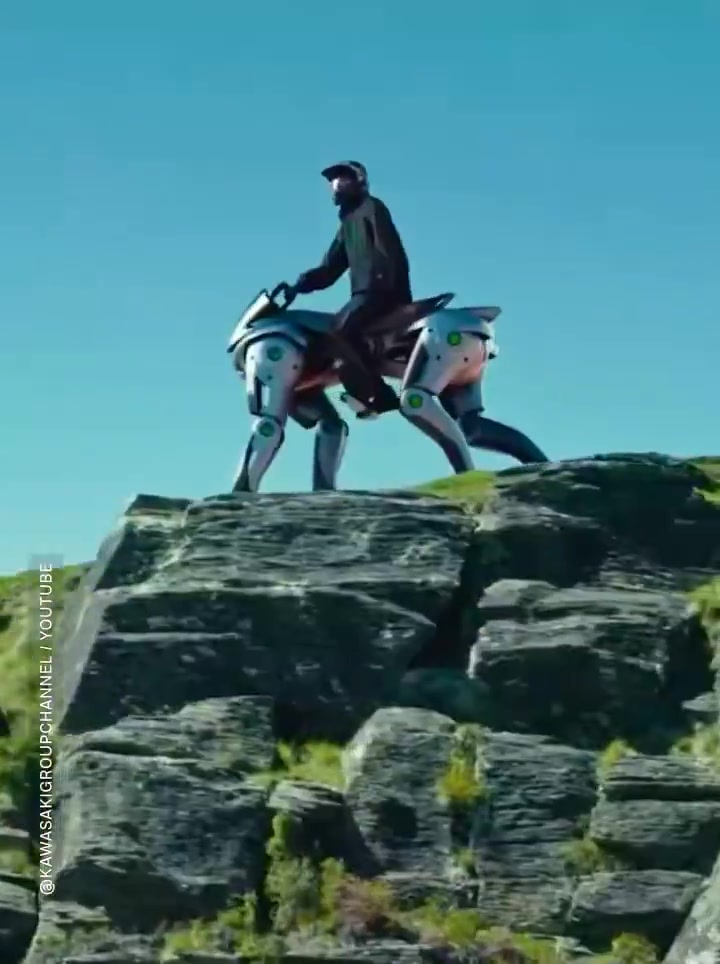
A rider crouches over a four-legged machine as it picks its way down a rocky slope, strides across a green hillside, and poses on a cliff top. When @sciencegirl shared the clip in January 2026, the caption said Kawasaki “has confirmed its Corleo robot horse will enter production, debut at Expo 2030 in Riyadh, and be sold to consumers by 2035.” The post drew about 440,000 impressions and 4,700 likes.1 It is a wonderful video, and it is also an animation.
So what is CORLEO, and what did Kawasaki actually commit to? We went to Kawasaki’s own announcements first.2 The short version: the company is serious, the timeline is long, and the caption runs a few steps ahead of the facts.
Video: Kawasaki’s computer-generated CORLEO concept film (Kawasaki Group YouTube channel), as shared by @sciencegirl. It shows the vehicle Kawasaki hopes to build, not a working machine, and the “officially going into production” text in the opening seconds is not accurate.
What CORLEO Actually Is
CORLEO is a four-legged vehicle you ride, built by Kawasaki Heavy Industries, the Japanese group that makes both industrial robots and Kawasaki motorcycles.2 Kawasaki calls it an RMV, short for Robotic Multi-legged Vehicle, designed mainly for off-road ground such as rocky trails.3 It has no throttle and no conventional steering. The rider steers by shifting body weight, much like riding a horse, through stirrups and handholds that sense those shifts.34
Power comes from a small 150cc hydrogen engine that does not turn the legs directly. It works as a generator, making electricity for the motors in each leg, with hydrogen stored in canisters at the rear.54 Kawasaki’s technical review describes six canisters in two sizes that can be swapped “like dry-cell batteries,” and sets a design target of at least 15 kW for the power unit.4
The feet are split rubber hooves meant to grip grass, rock, and loose gravel. The rear legs hang from a swingarm borrowed from motorcycle design, which soaks up shocks and keeps the saddle level on a climb so the rider can see the trail ahead.64 At night, a navigation panel is meant to project markers onto the ground to show the path.5
It’s Not Really a Horse
Everyone calls it a robot horse, including the caption. Kawasaki’s designers had a different animal in mind. They considered the cheetah, the fastest land animal, and chose the lion, judging it better for keeping the rider balanced and for “barreling across the landscape astride the king of the jungle.”7 The name comes from Cor Leonis, another name for the star Regulus, which Kawasaki ties to the lion.7
The team also wrestled with how much it should look like a motorcycle versus an animal. Kawasaki’s technical review says leaning too far toward the motorcycle would give “something like an ordinary vehicle just with legs attached,” while leaning too far toward the animal would drift away from the idea of a vehicle.4 To check comfort and safety, Kawasaki had riders from Kobe University’s equestrian club sit on a clay mock-up.4
What Kawasaki Actually Announced
CORLEO first appeared at Expo 2025 in Osaka in April 2025, where Kawasaki described it as a concept model for 2050.65 The concept film spread fast, and Kawasaki counts roughly 1.2 billion social media impressions.2 On X alone, one post by @BrianRoemmele passed 5.9 million impressions.8
That response changed the plan. On December 3, 2025, Kawasaki said it had launched development toward commercialization, set up a dedicated SAFE ADVENTURE Business Development Team reporting directly to the president, and was targeting use as an on-site mobility vehicle at Expo 2030 Riyadh, with commercialization in 2035.2 Nikkei reported in July 2026 that Kawasaki plans to finish a prototype by 2028, aims to start sales in 2035, and is targeting 300 billion yen in sales from CORLEO-related businesses by 2040.9
Kawasaki’s published roadmap fills in the steps. A riding simulator comes first, targeted for 2027. At Expo 2030, a new model is to be unveiled, when “the project will finally enter a phase in which people can ride the actual vehicle.” In 2035, CORLEO is to be released “mainly for the tourism and leisure industries.”10
Checking the Caption
Measured against those documents, the viral caption gets the direction right and the details a little early. “Enter production” overstates it. Kawasaki has announced development toward commercialization, not production, and the hardware shown in public so far is a full-scale mock-up that visitors can sit on.21112
“Debut at Expo 2030” is also off. CORLEO already debuted at Expo 2025 in Osaka. What Kawasaki plans for Riyadh is the unveiling of a new, rideable model, plus a goal, not a done deal, of using CORLEO as on-site mobility, including for security officers.6102
“Sold to consumers by 2035” is the loosest part. Kawasaki’s target is commercialization in 2035, aimed mainly at tourism and leisure, and the company says the price has not been determined.103 Australian Motorcycle News reads that plan as something “you’d rent rather than buy,” at least at first.13
The clip itself is a computer-generated concept film, not footage of a working machine. Motorcycle.com, Live Science, and New Atlas all made that point in April 2025, and Motorcycle.com noted that the Expo model could stand and adjust its posture but had very limited mobility.141516
Transport, Recreation, or Both?
Kawasaki’s answer leans hard toward fun. Its pitch rests on the idea that “people don’t move only for efficiency or convenience,” and its first market is tourism and leisure.310 Nikkei reported that after Expo 2030, Kawasaki also plans to propose a CORLEO riding park in Saudi Arabia.9
But there is a transport story too. The Riyadh plan is a working job: carrying security officers around an Expo site.10 Kawasaki’s technical review says the machine’s “use is not limited to leisure,” that its ruggedness would suit disaster rescue and relief, and that safe tandem riding is among the planned features.4 The wider SAFE ADVENTURE program adds a navigation system meant to warn riders about weather, ground conditions, and wildlife, with the goal of reducing mountain accidents.2
Our read is recreation first, transport second. A 2035 CORLEO looks most like a premium ride at a park or a guided mountain tour, with work roles following if the machine proves tough and affordable enough.
Why Legs, and Why Not a Humanoid?
Wheels are brilliant on roads and clumsy on broken ground. Legged-robot pioneer Marc Raibert estimated in 1986 that wheeled vehicles can reach only about half of Earth’s land, while animals on legs cover a far wider range of terrain.17 Kawasaki adds a rider’s reason: off-road motorcycles demand high skill and make a tumble “almost unavoidable,” and legs were chosen partly to make off-road riding safer.7
Kawasaki builds legged machines in both shapes. Its Kaleido humanoid has been in development since 2015 and is now in its ninth generation, aimed at places like disaster sites, where Kawasaki says a humanoid’s value lies in “adapting robots to the human world.”18 In 2022, IEEE Spectrum reported on Bex, a Kawasaki four-legged robot modeled on the ibex that has a seat and handlebars and can carry up to 100 kilograms.19
Kawasaki robotics developer Masayuki Soube explained the thinking in a machine translation quoted by IEEE Spectrum. A humanoid could in principle do everything people do, but “it will take a long time to put it to practical use,” so Kawasaki looked for something “halfway between humanoid robots and wheeled robots.”19 CORLEO takes that one step further. You do not need a robot shaped like a person when the person is riding on top.
History offers a caution, too. Boston Dynamics’ LS3, a DARPA-funded robotic pack mule, was designed to carry 400 pounds of a squad’s gear over rough terrain.20 The Marines set it aside in 2015, in large part because its gasoline engine was too loud for combat.21 CORLEO also burns fuel, hydrogen rather than gasoline, so how it sounds on a quiet mountain trail is a fair question.
What the Replies Got Right
The threads under the clip were part delight and part disbelief. The most common doubt was simple: is it real? “Some say it’s fake (it is),” replied @cixliv under the 2025 viral post, and @hashtagdooshbag asked why Kawasaki showed a CGI video instead of footage of someone riding it.2223 On the video, they were right, and Kawasaki itself describes CORLEO as still under development.3
Others asked practical questions. @queenalanicole pictured reaching a summit “and the battery dies.”24 CORLEO is a series hybrid fed by swappable hydrogen canisters, with a small battery under the seat rather than a plug-in pack, and Kawasaki has not published a range.425 @evjaus asked how long the motorized joints would last and whether legs beat a motocross bike, and Kawasaki’s own engineers list legs that are both durable and lightweight as one of the hard problems still ahead.264
Then there were the fans, who compared CORLEO to mounts from video games and anime, and Kawasaki leaned in. At gamescom 2026 in Cologne, about 6,100 people sat astride the full-scale mock-up over five days.311 The most common question at the booth was “When can I ride it?”3
Looking Ahead
Watch three milestones. The riding simulator is due in 2027, Nikkei reports a prototype in 2028, and Expo 2030 is where people are supposed to ride a real CORLEO for the first time.109 If those land on schedule, 2035 starts to look less like a poster and more like a plan.
We hope Kawasaki pulls it off. A machine that lets a beginner ride safely up a mountain would be a genuinely new kind of fun, and maybe a useful tool when roads wash out. For now, CORLEO is a serious program with a mock-up, a roadmap, and a great animation, not a product you can buy. Thanks to @sciencegirl for sharing the clip, and to Kawasaki for the concept film and the paper trail.
Related Articles
- DEEP Robotics Unveils New Robot Horse Model
- XSTO X12: Dual-Mode All-Terrain Mobility Robot
- Genisom AI M1 Robot Dog Handles Land and Water
- Rethinking Humanoid Robots: Insights from Inference Labs and Community Discussions
- Why Hands Are the Hardest Part of Tesla's Optimus Robot
Sources for this article
- Science girl (@sciencegirl) on X: Kawasaki has confirmed its Corleo robot horse will enter production (Jan 14, 2026)
- Kawasaki Heavy Industries, Kawasaki Launches Development of “CORLEO,” a New Type of Futuristic, Off-Road Personal Mobility Vehicle (Dec 3, 2025)
- Kawasaki Heavy Industries ANSWERS, Why Did CORLEO Head to a Gaming Festival? gamescom 2026
- Kawasaki Technical Review No. 187, CONCEPT 01 CORLEO: Novel interactive four-legged off-road mobility (Feb 2026, PDF)
- Kawasaki Motors Europe, “CORLEO” concept unveiled (Apr 10, 2025)
- Kawasaki Heavy Industries, Showcasing CORLEO at Expo 2025 Osaka, Kansai (Apr 3, 2025)
- Kawasaki Heavy Industries ANSWERS, Behind-the-Scenes Story of Kawasaki’s Futuristic Mobility Concept Showcased at Expo 2025
- Brian Roemmele (@BrianRoemmele) on X: Meet the new Kawasaki CORLEO (Apr 4, 2025, U.S. time)
- Nikkei, Kawasaki Heavy Industries’ four-legged robot CORLEO: prototype in 2028 (in Japanese, Jul 28, 2026)
- Kawasaki Heavy Industries, SAFE ADVENTURE: SA Roadmap
- Kawasaki Heavy Industries, Kawasaki to Exhibit Full-Scale Mock-Up of CORLEO at gamescom 2026 (Aug 19, 2026)
- Kawasaki Motors Europe, Kawasaki to Exhibit “CORLEO” Robotic Multi-legged Vehicle at EICMA (Oct 28, 2026)
- Australian Motorcycle News, 4-legged Kawasaki Corleo promised for production
- Motorcycle.com, Save a Horse, Ride a Kawi: The Kawasaki Corleo Concept (Apr 2025)
- Live Science, Hydrogen-powered ‘robot horse’ could one day take you up a mountain (Apr 2025)
- New Atlas, Kawasaki unveils Corleo, a hydrogen powered robot horse concept (Apr 2025)
- Frontiers in Robotics and AI, Kinematic Analysis of VibroBot (2016), citing Raibert (1986) on wheeled access to Earth’s landmass
- Kawasaki Robotics, The Current Goals of Kaleido 9 as a Humanoid Robot (Mar 16, 2026)
- IEEE Spectrum, Kawasaki’s Robot Ibex: Can It Be Tamed? (Mar 9, 2022)
- DARPA, Legged Squad Support System (LS3)
- Ars Technica, Marines’ LS3 robotic mule is too loud for real-world combat (Dec 2015)
- Reply by @cixliv: “Some say it’s fake (it is)”
- Reply by @hashtagdooshbag: why not publish footage of it being ridden instead of a CGI video?
- Reply by @queenalanicole: imagine reaching the top of the mountain and the battery dies
- The Gadgeteer, Kawasaki’s robot horse is headed for production with a 2035 deadline (Nov 11, 2026)
- Reply by @evjaus: how long do the motorized joints last, and does it beat a motocross bike?
Leave a Reply