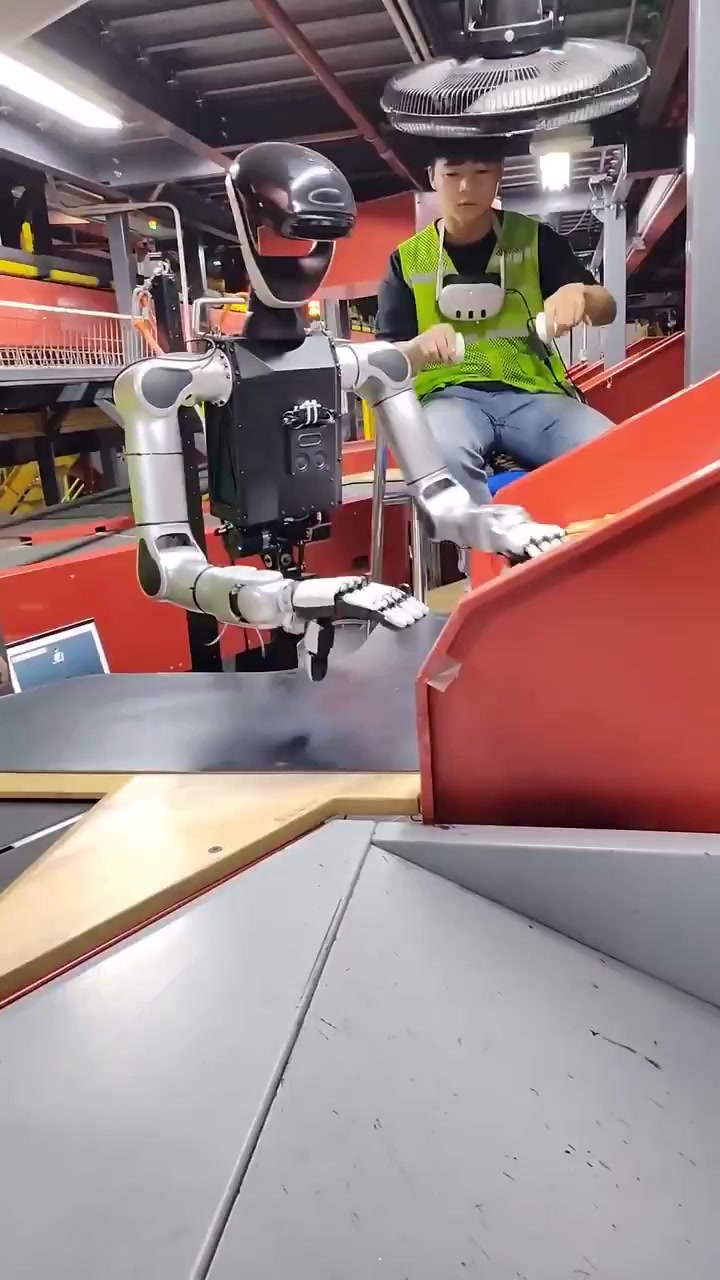
A recent video shows a worker training a robot to sort packages on a conveyor line, raising questions about whether he is preparing his own replacement.1 This scene captures the shift toward the next era of automated warehouses, where software orchestration and AI integration take center stage.3 Critics in replies point out that humans still oversee the process, and current speeds lag behind experienced workers or high-speed conveyors.
Current Trends in Warehouse Automation
The next era of automated warehouses focuses on software orchestration, AI integration, and flexible robotics like autonomous mobile robots (AMRs) and shuttles.1 These systems optimize existing spaces amid labor shortages and e-commerce growth, moving beyond hardware expansion to intelligent decision-making.3 Real-time warehouse execution systems (WES) platforms bridge warehouse management systems and robots for better efficiency.
AMRs use sensors to navigate without operators, unlike guided AGVs.1 This flexibility helps in non-traditional layouts for grocery distribution and more.6
Leading Companies and Products
Symbotic leads with a $31.3B market cap, offering end-to-end AI-powered robotic systems and SymBots for case handling in high-density storage.5 GreyOrange, with $545M in funding, specializes in AI orchestration for multi-category robots, while Locus Robotics and 6 River Systems focus on AI for sorting and picking.15 Mytra provides AI-powered 3D robotics for modular AS/RS handling heavy pallets up to 1,360kg.
Shuttle-based systems enable high-density storage up to 131 feet deep with fast lane operations.1 These competitors differentiate through fulfillment science beyond basic movement.
Technical Capabilities
WES sits between WMS/ERP and execution tech, making real-time decisions for robots and people.36 AI vision systems learn new products for picking, and neural networks predict using warehouse data while managing robot traffic.12 Predictive maintenance uses performance data to cut downtime.
These tools address skepticism about robot speeds, as one reply noted a robot sorting one box every three seconds versus humans at four to five or conveyors at twenty to thirty.1 Yet, full integration promises better overall flow.
Demonstrations and Real-World Use
Symbotic demos modular systems automating pallet breakdown with SymBot fleets.5 Shuttles fill or empty lanes quickly with one command, boosting productivity.1 AI robots handle sorting, picking, packing, and inventory in real time.
Replies question why humans remain, especially in training like Wii-style control, but this phase builds toward autonomy.1 The trainer may indeed feel replaceable, as automation targets repetitive tasks.
Impact on Labor and Operations
Automation tackles labor shortages and costs by reducing repetitive cargo movement.14 The market grows from $21.23B in 2024 to $105.45B by 2035 at 15.69% CAGR, driven by e-commerce.5 By 2027, 26% of warehouses will be automated, up from 14% a decade ago.
Paths Forward / Looking Ahead
By 2026, software like WES will orchestrate AMRs, shuttles, and people in real-time without messy stacks of tech.3 Over 50% of organizations plan AI for vision and maintenance in five years, shifting to decision intelligence from reports.2 Flexible modular solutions and Robots-as-a-Service will rise, emphasizing software-defined systems over rigid ones.57
This evolution addresses concerns like dexterous hands or supervillain risks by focusing on controlled, optimized environments first.1 While full human elimination lags, training roles evolve as robots take mundane jobs, potentially replacing trainers too.5 The result points to efficient warehouses supporting broader economic shifts.
Related Articles
- Upgrading the Human Edge: Automation, Robots, and the Path to an Age of Abundance in Warehousing.
- The Explosive Growth of the Robotics Market: Humanoids Leading the Charge to 375 Billion by 2035
- Youibot Robotics: Integrated Automation Solutions for Semiconductor Manufacturing
- Sharp Robotics’ Sensor-Laden Hand at CES: Tackling the Last Mile of Dexterity
Sources for this article
- Warehouse automation trends including AMRs and shuttles
- Future of warehouse automation trends
- Warehouse automation trends for 2026: software era
- 26% of warehouses automated by 2027
- Fastest growing warehouse automation companies
- Navigating future warehouse robotics automation
- 2026 trends in warehouse automation
Leave a Reply