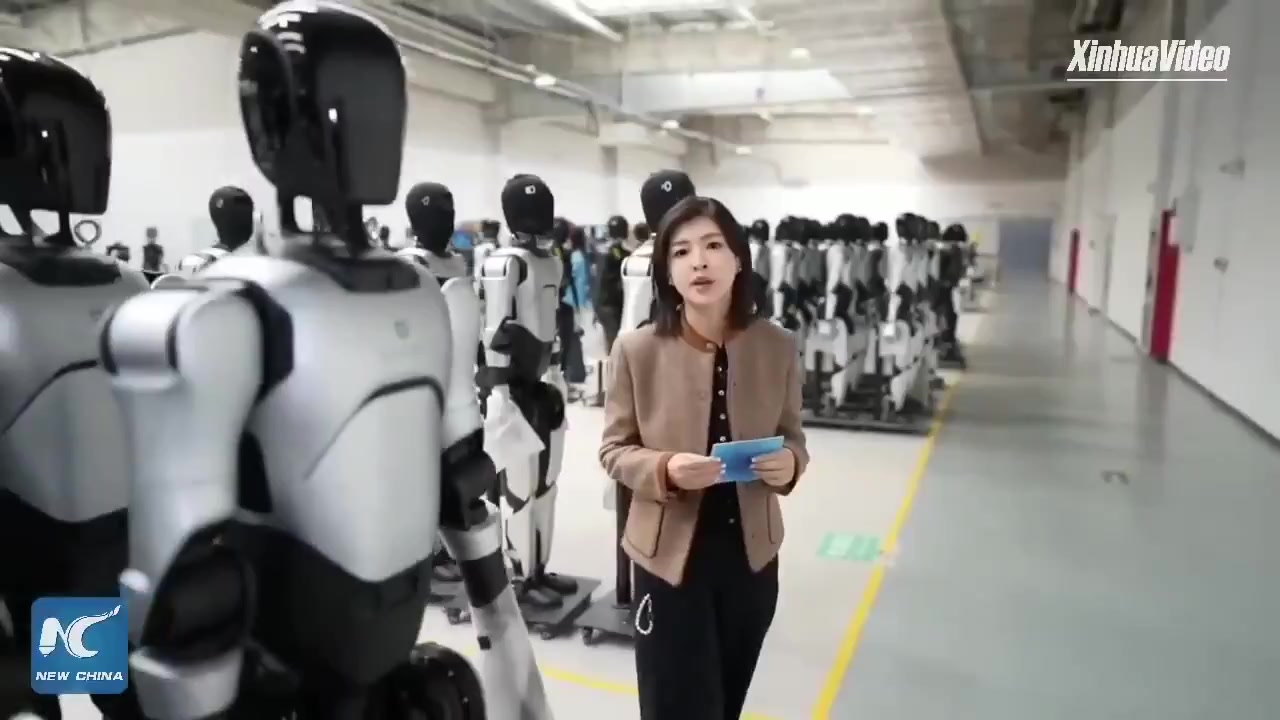
AGIBOT, a Shanghai-based company founded in 2023, has emerged as the global leader in humanoid robot shipments for 2025, delivering more than 5,100 units and securing 39% of the market according to Omdia’s report.1 The firm made its U.S. debut at CES 2026, showcasing a diverse portfolio that spans full-sized humanoids, compact models, and wheeled robots.15 And so it begins—we really are experiencing rapid acceleration in robotics capabilities.
Company Background
Headquartered in Shanghai, AGIBOT specializes in embodied intelligence and AI-robotics integration.1 The company operates on a foundation of the ‘robotic body + 3 intelligence’ model, which integrates interaction, manipulation, and locomotion intelligence.1 Founded in 2023, it marked a key milestone by announcing its 5,000th general-purpose embodied robot rolled off the production line on December 8, 2025.4
AGIBOT began mass production of general-purpose robots in December 2024, following an aggressive development pace.4 This rapid scaling reflects China’s lead in humanoid robotics, as noted in industry discussions.2 Skeptics question the practical utility of these shipments, demanding demonstrations of real-world tasks beyond shows.
Product Portfolio
The company unveiled its first model, the Yuanzheng A1 intelligent robot, in August 2023.4 By August 2024, AGIBOT introduced five new commercial humanoid models across the Yuanzheng and Lingxi series, with the Lingxi X1 announced as open source in October 2024.4 Its full lineup went on sale in August 2025, including six product lines: Yuanzheng A2, Lingxi X2, Jingling G1, OmniHand dexterous hand, D1 quadruped robot, and Juechen C5.4
AGIBOT has built a diversified portfolio spanning full-sized humanoids, compact half-sized humanoids, and wheeled embodied robots.1 For instance, compact models like the Q1 fit in a backpack for research purposes, as detailed in prior coverage on AGIBOT’s Q1. These designs support deployments in varied sectors.
2025 Shipment Milestone and Market Share
The global humanoid robot market saw rapid growth in 2025, with approximately 13,000 units shipped and Chinese manufacturers capturing 87% of production.12 AGIBOT shiped more than 5,100 humanoid robots, ranking No. 1 in both volume and market share.1 This dominance underscores effective logistics in mass production, though some argue the challenge lies in intelligence rather than volume.
Competitive Landscape
Unitree Robotics, based in Hangzhou, ranked second with 4,200 units shipped, holding 32% market share.3 UBTech Robotics in Shenzhen placed third with 1,000 units, while Leju Robotics, Engine AI, and Fourier Intelligence followed.3 The top three Chinese firms accounted for 78% of the global market, with U.S. makers like Tesla, Figure AI, and Agility Robotics each shipping just 150 units—less than 13% total.2
Models like Unitree’s G1 demonstrate athletic capabilities in training demos, as seen in reports on Unitree G1 jumps and punches.2 Questions arise whether Tesla’s Optimus can match these numbers in 2026. Chinese firms set benchmarks in large-scale production.
Commercial Deployments
AGIBOT’s humanoids deploy across reception and hospitality, entertainment, industrial manufacturing, logistics sorting, security patrol, data collection, and scientific research.1 These applications highlight versatility beyond prototypes. While some view Chinese robotics as showmanship, actual shipments indicate real integration.
Technical Foundations
AGIBOT integrates robotic body technology with interaction, manipulation, and locomotion intelligence.1 The emphasis on AI-robotics fusion supports general-purpose embodied robots.4 This foundation enables stable operations in diverse environments.
CES 2026 Debut
At CES 2026, AGIBOT took home multiple Best of CES awards.5 The event marked entry into the U.S. market. It showcased the breadth of applications already in play globally.
Paths Forward / Looking Ahead
Omdia forecasts exponential growth, with global annual shipments reaching 2.6 million units by 2035.1 The market will expand into service sectors like healthcare and hospitality, where robots collaborate with humans in personalized interactions.2 Competitors like Boston Dynamics plan factories for 30,000 units annually, while others target 50,000 by late 2026—pressuring leaders to innovate beyond production scale.
Mass production proves logistics mastery, but true advancement demands sophisticated decision-making in unstructured settings.2 As humanoids enter homes and workplaces, ethical considerations around jobs and privacy will intensify. Chinese dominance may spur global catch-up, fostering a competitive ecosystem that accelerates practical deployments.
Sources for this article
- Omdia ranks AGIBOT No.1 worldwide in humanoid robot shipments in 2025
- China’s AGIBOT tops global humanoid robot shipments in 2025
- Chinese firms outpace US rivals in 2025 humanoid robot shipments; AGIBOT takes lead
- AGIBOT tops the global humanoid robot shipments ranking
- AGIBOT’s CES 2026 debut and awards
Leave a Reply