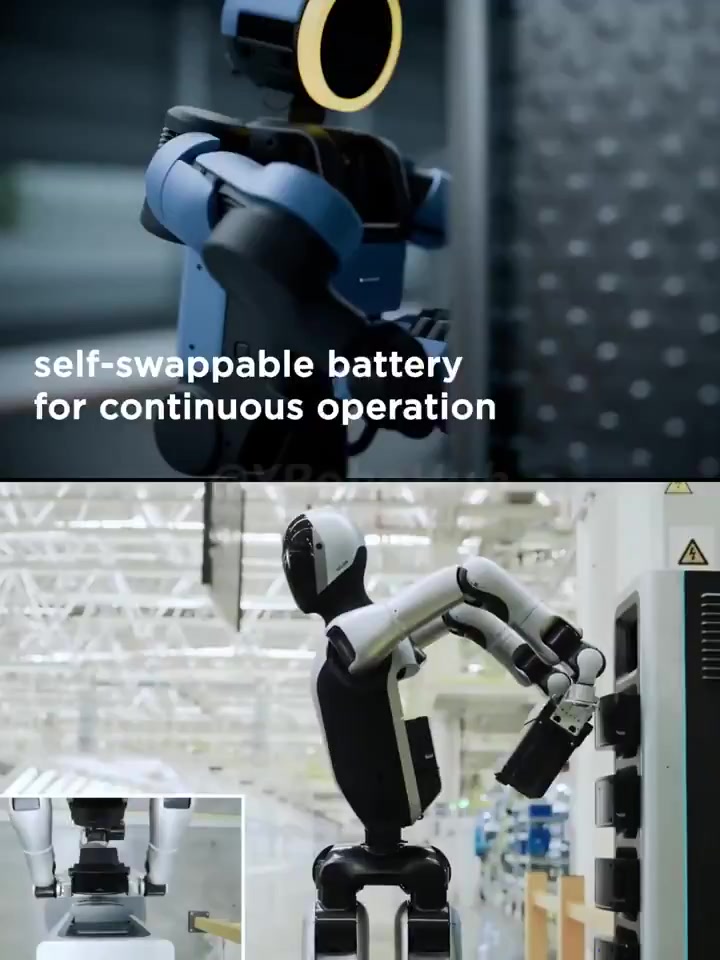
Self-swappable batteries allow robots to autonomously replace depleted batteries with charged ones, enabling continuous 24/7 operation without human intervention or downtime.1 This concept, highlighted in a recent X post questioning if such systems could truly support round-the-clock work, draws attention through demonstrations like those in humanoid robots. While replies raise valid points on challenges like battery replacement logistics and alternatives such as wireless charging, the underlying engineering shows promise for operational autonomy.
Understanding Self-Swappable Battery Systems
Hot-swappable battery systems rely on lithium batteries with high energy density and fast charging capabilities tailored for robotic applications.1 Dual battery packs ensure seamless operation, as one pack powers the robot while the other is swapped or charged. Automated battery swap stations further support this by handling high-capacity exchanges to maximize uptime.
These systems address downtime issues common in battery-powered devices, particularly in demanding environments like industrial settings or remote operations. The core idea is uninterrupted power supply, much like in uninterruptible power systems for medical equipment.2 For robots, this translates to sustained productivity without pauses.
Technical Principles of Hot-Swapping
Microcontroller-based hot swapping employs multiple batteries, where the one with the highest voltage supplies power as others are replaced.3 FET-controlled circuits or ideal diode ICs minimize voltage drops to near zero, reducing heat generation during transitions. Intelligent controllers offer real-time monitoring, predictive analysis, and load balancing for safety.
Seamless swaps feature power interruptions under 100 microseconds and inrush currents limited to less than 5% of rated capacity.2 Microcontrollers in each battery verify rail voltage before connecting via safety FETs, ensuring safe integration of new units. These mechanisms make self-swapping feasible even for mobile robots.
Demonstrations in Action
The UBTECH Walker S2 robot exemplifies this technology by autonomously replacing its battery in under three minutes while staying operational.1 Its dual-battery setup switches to the backup during the process, preventing any performance hiccups. Such demos confirm the practicality for humanoid robots in real-world tasks.
These capabilities boost production efficiency by enabling true 24/7 work cycles for robots.1 While other robots with similar features are emerging, UBTECH’s implementation stands out in current deployments. Videos of these swaps highlight the precision required for autonomous execution.
Addressing Key Challenges from Discussions
One common question is how a robot replaces the battery powering its swapping mechanism — dual systems solve this by keeping a charged pack active throughout.1 Replies to the original post suggest wireless charging relays or nuclear options, but swappable bateries offer quicker, more reliable exchanges without infrastructure dependency. Thermal management and maintenance remain bigger hurdles than runtime alone.
Applications Across Industries
In industrial robotics, hot-swappable batteries allow adaptation to urgent tasks without intervention, enhancing flexibility.1 Similar tech appears in electric vehicles, where swap stations replace batteries in minutes to combat range anxiety.4 Stations can charge multiple units simultaneously, scaling for fleets like scooters or robot swarms.
For medical and UPS systems, these prevent critical interruptions.2 In robotics, the impact extends to logistics and manufacturing, where uptime directly ties to output. Self-maintenance via swaps paves the way for longer missions.
Battery Types and Competitors
Lithium-ion batteries dominate due to their energy density and charging speed, ideal for swapping.5 LiFePO4 variants provide added safety and cycle life as alternatives. Emerging solid-state batteries promise even higher density for future stations, though commercialization lags.
Paths Forward / Looking Ahead
Self-swappable batteries could transform robots into self-sustaining units, especially when paired with solar power generation. Imagine fleets building solar facilities on Earth or Mars, swapping batteries charged by the sun to achieve near-perpetual operation with minimal oversight. This evolves toward self-maintenance ecosystems, where robots service each other, reducing human involvement and costs over time. Modular designs will further lower ownership expenses across battery types.2
Autonomous swapping stations enhance efficiency for continuous work, but integration with AI for predictive swaps will be crucial. As thermal and part replacement challenges are met, these systems hint at servant robot populations capable of long-term independence. Early adopters in factories demonstrate viability, setting the stage for extraterrestrial applications. Overall, this technology bridges current limits toward fuller robotic autonomy.1
Leave a Reply