Cobot financing is usually a three-to-seven-year equipment lease or loan on the installed cell, not just the robot arm. In 2026, that arm is often less than half of the project cost. The question that matters is whether the monthly payment still clears a realistic payback after integration, tooling, and the safety work that a risk assessment may require, the same test as for warehouse robot ROI.
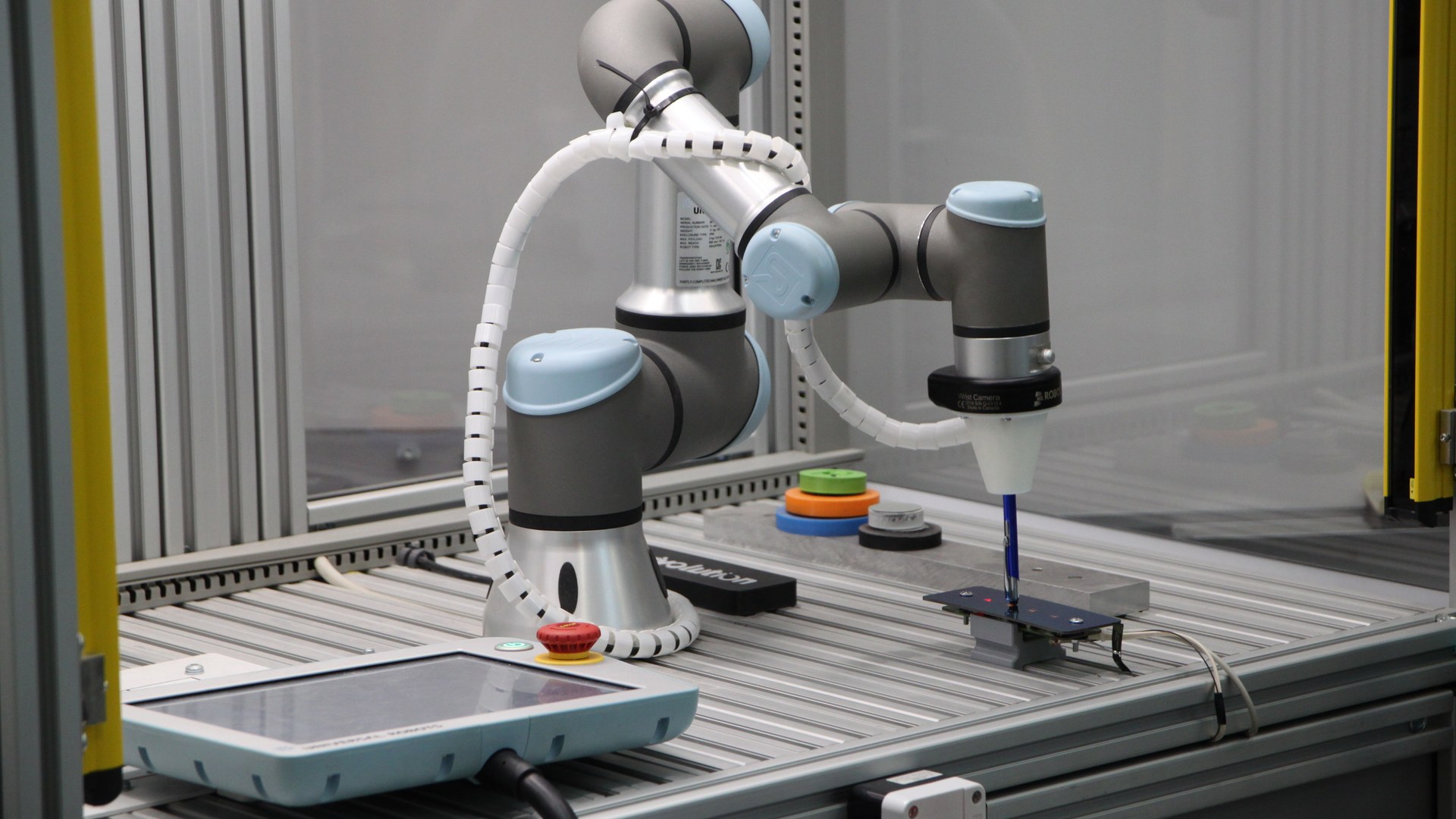
A collaborative robot, or cobot, is an industrial arm designed to work near people, with built-in safety functions such as power and force limiting. It is not, by itself, a complete production system. Grippers, fixtures, part presentation, machine interfaces, programming, and safeguarding turn the arm into a cell. Those lines, not the catalog price, usually decide whether a shop should buy, lease, or subscribe.

What a cobot costs before anyone talks about financing
Price guides for 2026 put the arm and the working cell in different brackets, and they should be read as vendor ranges, not quotes. Anton Robots, in a July 22, 2026 guide, says the collaborative arm itself typically costs $20,000 to $70,000, with compact models starting near $15,000 and heavy-payload systems sometimes exceeding $90,000. With gripper, vision, fixtures, safety equipment, controls, engineering, and commissioning, it places most commercial cobot projects between $45,000 and $175,000, and advanced palletizing, welding, finishing, mobile, or multi-machine systems at $250,000 or more.1
A late-October snapshot of published U.S. list prices is a useful check. Relling, a robotics integrator, recorded listings on October 24, 2026: a Fairino FR5 at $6,999, a Universal Robots UR3e at $33,011, a FANUC CRX-10iA at $51,433.73, a UR30 at $61,415, and a UR20 at $62,990, generally for the arm and controller, with pendants and cables varying by listing.2 Its rule of thumb is that a working cell typically costs two to three times the arm.2
The job matters more than the brand. In Anton's application table, testing and inspection cells are often cited at $40,000 to $100,000, machine-tending systems at $60,000 to $160,000, cobot welding at $80,000 to $160,000 or more, and cobot palletizing at $85,000 to $220,000.1 The same extras show up in factory work that is not cobot work: integrated industrial automation is more than a single arm, and pallet-moving robots or welding cells add tooling and process equipment the manipulator does not include. Kepler's teleoperated welder is a humanoid demonstration, not a cobot, but the welding cell's extras are the same kind of bill.
In Anton's CNC machine-tending example budget, a $40,000 medium-payload cobot sits inside an $118,000 installed total; the arm is about one-third of the bill.1 Packaged cells are another benchmark. Both Anton and Relling point to Hirebotics' published starting price of $105,000 for a pre-engineered cobot welder, a narrow, one-job package, not a custom cell.12
Payback follows utilization more than the sticker on the arm. Relling's illustrative worksheet, not a customer result, puts a $110,000 cell at about 13 months across two shifts and about 28 months on one, using $35 an hour in loaded labor and 1,500 hours freed per shift, minus $5,000 a year in upkeep.2 Anton's equally illustrative $118,000 tending cell with $75,000 in annual net benefit pays back in about 1.6 years.1 Named-customer figures can be shorter or longer. In a Universal Robots case story, MT Solar, a small Montana manufacturer of solar mounts, used rent-to-own options through Vectis Automation on a UR10e welding cell; owner Travis Jordan described “a real clean one-and-a-half, two-year ROI, just on hard number labor savings.”3 That is a company-reported claim, not an industry average.
How cobot financing is usually structured
Lenders that finance automation typically underwrite the cell, not only the serial number on the arm. Bay Street Lending, in a September 2026 explainer, says industrial robot financing commonly covers grippers and tooling, vision, safety guarding, controls, and programming when those items appear on the integrator's quote, because the arm does nothing without them.4 It describes typical terms of 36 to 84 months, advertised APRs from 6 to 22 percent, and down payments from 0 to 20 percent, with credit, time in business, and the labor or throughput case all affecting the offer.4 Those are lender ranges, not a rate available to any particular shop.
Sample payments should be treated the same way. Bay Street's examples include a $95,000 cobot machine-tending cell at 10 percent APR over 48 months, shown as about $2,410 a month, and a $250,000 welding cell at 9.5 percent over 60 months, shown as about $5,250 a month.4 The figures are illustrative and credit-dependent, not a quote or a recommendation.
A third path is robotics as a service, or RaaS: a recurring fee that may bundle the hardware, support, and sometimes the programming. Anton notes that the contract should define uptime, service response, production changes, and early termination, and that a low monthly figure is not automatically the lowest lifetime cost.1 Relling's 2026 worksheet on an illustrative $180,000 cell over 60 months puts a cash purchase at about $200,000 including maintenance, or about $175,000 after a $25,000 resale; a $1-buyout lease at 8.5 percent at about $241,600 in payments plus maintenance; and a $4,900-a-month RaaS contract at $294,000, with no capital outlay and with maintenance and upgrade risk shifted to the provider.5 Those numbers are a worked example, not an offer. MT Solar's short-term rent-to-own arrangement is a real, if company-reported, case of testing a welding cell before taking on a long obligation.3
Lease versus buy (FMV lease vs $1-buyout / loan)
The lease-or-buy choice is the same one shops already make on machine tools. Paying cash avoids interest if the cell will run for years and the cash is not needed elsewhere. Leasing spreads the cost and can keep a credit line free, but it does not make the cell cheaper.
Two common equipment-lease structures do different jobs. In a fair-market-value, or FMV, lease, monthly payments are typically lower. At the end of the term, often 36 to 60 months, the lessee can return the equipment, renew, or buy it at then-current fair market value. The Machine Daily, in a July 9, 2026 trade guide, says that end-of-term purchase price is often estimated at about 10 to 18 percent of the original invoice.6 In a $1-buyout lease, sometimes called a capital or finance lease, the payments are higher—The Machine Daily says often 15 to 25 percent higher than a comparable FMV lease—and the lessee owns the equipment for a nominal dollar at the end.6 Those percentages are a trade publication's description of typical structure, not a rate sheet.
Tax treatment follows the form of the deal. For tax years beginning in 2026, the Internal Revenue Service says the maximum section 179 expense deduction is $2,560,000, reduced as the cost of section 179 property placed in service exceeds $4,090,000.7 Whether a particular cobot cell, and the integration around it, qualifies, and whether a given lease is treated as a true lease or as a purchase, is a question for a qualified tax adviser. This is not tax or financing advice.
Safety and standards that affect the real bill (ISO/TS 15066, risk assessment)
A cobot's built-in safety functions do not erase the safety line from the quote. The Occupational Safety and Health Administration currently has no specific OSHA standard for the robotics industry.8 Shops still have to meet general machine-guarding, lockout, and related duties, and they commonly look to consensus standards for details.
The international reference for collaborative industrial robot systems is ISO/TS 15066:2016, which supplements the industrial robot safety requirements in ISO 10218-1 and ISO 10218-2.9 ISO confirmed the technical specification in 2022; as of June 26, 2025, it lists the document as a standard to be revised, with a successor, ISO/AWI 15066-1, under development.9 In the United States, OSHA notes that RIA TR R15.606 is the national adoption of ISO/TS 15066, alongside ANSI/RIA R15.06, the U.S. adoption of ISO 10218.8 Canada's CCOHS, in a 2022 fact sheet, describes the usual collaborative modes—speed and separation monitoring, hand-guided controls, power and force limiting, and safety-rated monitored stop—and says collaboration should be used only when it is necessary, and only with a robot designed for it.10
That is why a fence-free brochure is not a budget. A slow inspection camera and a sharp welding torch, or a 25-kilogram box moving at production speed, are different risk problems. Anton, again as vendor ranges, cites indicative costs of $2,000 to $10,000 or more for an application risk assessment and validation, $4,000 to $15,000 for a safety laser scanner or light curtain per protected area, and $8,000 to $40,000 or more for complete fencing and doors when the assessment requires them.1 Those figures will move with the cell, and they belong in the amount financed.
The same caution applies when comparing cobot cells with other factory robots. Schaeffler's planned factory deployment of wheeled humanoids is a real production context, but a humanoid is not a cobot, and it should not be financed, or risk-assessed, as if it were one.
Looking Ahead
Collaborative arms are no longer a novelty, but they are still a minority of the industrial robot market. In its World Robotics 2026 figures, released September 24, 2026, the International Federation of Robotics reported 66,000 new cobot installations in 2025, 11 percent of 603,000 industrial robots overall. For the first time since the IFR began tracking cobots, their 7 percent growth lagged the broader market's 11 percent rise.11 That is a reminder that most factory robots are still conventional cells, and that a first cobot project is a financing and integration problem, not a catalog purchase.
The safety rulebook is also in motion: ISO/TS 15066 is slated for revision. The financing question is less likely to change. Whether the deal is a $1-buyout lease, an FMV rental, a loan, or a service contract, the test remains the same. Add the arm, the tooling, the integration, and the safeguards the risk assessment actually requires. Subtract only the labor and scrap the schedule will really give up, minus upkeep and the finance charge. Then ask whether the monthly payment still fits.
FAQ
How much does a cobot cost in 2026?
There is no single cobot price. Anton, in a July 2026 vendor guide, puts typical arms at $20,000 to $70,000 and most installed systems at $45,000 to $175,000, with heavier cells higher.1 Relling's October 24, 2026 snapshot of published listings ran from $6,999 for a budget Fairino FR5 to $62,990 for a UR20, and it treats a working cell as usually two to three times the arm.2 Those are dated ranges and list prices, not a quote for the next job.
Does cobot financing cover integration, or only the arm?
It can cover both, but only if the deal is written that way. Bay Street Lending says automation lenders commonly include tooling, vision, safeguarding, controls, and programming when those items are on the integrator's quote, because the robot cannot run without them.4 A robotics-as-a-service contract may bundle hardware and support into a monthly fee, which should be compared on total term cost, not the first invoice.15 Ask what is in the financed amount before comparing payments.
Should I lease or buy a cobot?
That depends on cash, how long the job will last, and who should carry maintenance and residual-value risk. Paying cash is usually cheaper over a long, stable life if the money is not needed elsewhere; a lease preserves working capital; RaaS can lower the upfront commitment at a higher five-year total in integrator illustrations.5 No figure in this article is a recommendation or a rate you will be offered. Run the payback on the installed cell, then take the term sheet to a finance and tax adviser.
What is the difference between an FMV lease and a $1 buyout?
An FMV, or fair-market-value, lease typically has lower monthly payments. At the end of the term, often three to five years, you may return the equipment, renew, or buy it at then-current fair market value. A $1-buyout lease works more like a loan: payments are higher, and you own the cell for a nominal dollar when the term ends.6 The Machine Daily's 2026 guide describes end-of-term FMV purchase prices often estimated at about 10 to 18 percent of the invoice, and $1-buyout payments often 15 to 25 percent higher than a comparable FMV lease; those are trade-article descriptions, not a quote.6
What safety rules apply to collaborative robots?
OSHA has no specific robotics standard; general machine-guarding and related rules still apply.8 The usual technical references are ISO/TS 15066:2016 for collaborative industrial robot systems, which supplements ISO 10218, and, in the United States, RIA TR R15.606, the national adoption of that technical specification.89 A cobot's power- and force-limiting functions do not automatically make a cell fence-free. A documented risk assessment of the arm, the tool, the part, and the speed decides what safeguarding the bill must include.10
Related Articles
- Schaeffler and Humanoid: Can Wheeled Robots Make It in Real Factories?
- Youibot Robotics: Integrated Automation Solutions for Semiconductor Manufacturing
- Kepler K2 Welds High Up by VR: Real Job or Robot Demo?
- Filics Robots Turn the Pallet Move Into a Software Job
Sources for this article
- Miguel Anton, Anton Robots, Cobot Price Guide 2026: Robot, Tooling & Integration (July 22, 2026). Vendor ranges, indicative 2026 market figures in U.S. dollars, generally excluding tax, freight, and duties.
- Relling, Cobot price: what a cobot really costs, arm to working cell (listed prices recorded October 24, 2026, from vendor and U.S. reseller pages, including Vention, Top3DShop, and others cited on the page; cell-cost and payback worksheets are illustrative). Integrator guide.
- Universal Robots, MT Solar (company case story; payback and financing comments are MT Solar's claims about a Vectis Automation cobot welding tool on a UR10e).
- Bay Street Lending, Industrial Robot & Cobot Financing: Cells and Integration (updated September 2026). Lender explainer; rates, terms, and sample payments are illustrative and credit-dependent, not a quote.
- Relling, Robot Leasing vs Buying vs RaaS (2026): Worked Comparison. Integrator worked example on an illustrative $180,000 cell; not an offer.
- David Okonkwo, The Machine Daily, How to Lease Manufacturing Automation Equipment: 2026 Guide (July 9, 2026). Trade article on FMV versus $1-buyout structure, not a rate sheet. Arm “outright purchase” figures in that article's table were not used here, because they do not match dated public listings recorded later in 2026.
- Internal Revenue Service, Publication 946 (2025), How To Depreciate Property, “What's New for 2026.” Section 179 dollar limits for tax years beginning in 2026. Not tax advice.
- U.S. Occupational Safety and Health Administration, Robotics – Standards. OSHA states there are currently no specific OSHA standards for the robotics industry; the page lists consensus standards, including ANSI/RIA R15.06 and RIA TR R15.606.
- International Organization for Standardization, ISO/TS 15066:2016, Robots and robotic devices — Collaborative robots (published February 2016; confirmed 2022; listed as to be revised as of June 26, 2025, with ISO/AWI 15066-1 under development).
- Canadian Centre for Occupational Health and Safety, Robots and Cobots (fact sheet first published and last revised October 7, 2022).
- Jane Heffner, International Federation of Robotics, President's Report (September 24, 2026), presenting World Robotics 2026 statistics, including 66,000 cobot installations in 2025.
Leave a Reply