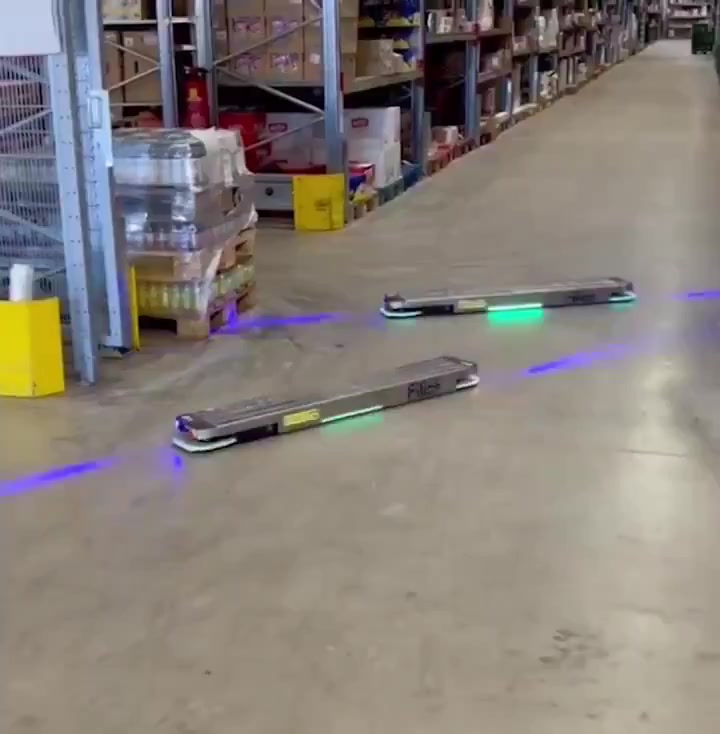
On January 12, 2026, @TansuYegen posted a 68-second clip captioned “The end of forklift,” showing pairs of flat robots from the Munich startup Filics sliding under loaded pallets, lifting them, and gliding away in any direction.1 By mid-November the post had passed 6.6 million impressions, 44,000 likes, and 3,500 replies.1 The caption says the units lift up to 1 ton. Filics’ own product page lists today’s Filics Streamliner at up to 800 kilograms, with a higher maximum planned for future versions.23
Here is our opinion. The heavy, repetitive part of a pallet move — the ride from point A to point B — is a good job for a robot. When that leg becomes software-defined work, warehouses should get safer and, over time, cheaper to run. That does not mean the forklift is finished, and the replies under the post made sure everyone knew it.
Video: Filics robots moving pallets, as shared by @TansuYegen.
What Filics Actually Built
Filics GmbH was founded in Munich in 2019 and grew out of the Technical University of Munich; the name stands for “Future in Logistics.”3 Its product is an autonomous mobile robot, or AMR: a vehicle that plans its own path with onboard sensors instead of following wires or tape in the floor. The Streamliner is what Filics calls a double-runner system. Two ultra-flat, independent robots drive underneath a pallet, lift it from below, and carry it without turning, maneuvering, or repositioning.2
Each runner measures 1,350 by 200 by 92 millimeters, so the pair stands about nine centimeters tall.2 Filics lists a top speed of 1.2 meters per second, up to six hours of operation, and a 30-minute charge, with laser-based navigation and docking at the charger on its own.2 For now it carries EPAL and H1 pallets, and the company says it needs indoor use, smooth and level floors, and stable Wi-Fi coverage.3
This is the third generation; earlier versions were sold as the Filics Unit, the name in the viral caption.14 Filics’ timeline says Bosch, DHL, and Nagel deployed the technology in the field in 2023, the year of its seed round, that a second generation reached its first customers in 2025, and that the Streamliner launched in 2026 as a fully industrial product.5 At LogiMAT 2026 the company showed redesigned lifting modules, a new laser-scanner layout, software rebuilt from the ground up, and compatibility with VDA 5050, an interface standard that the company says lets the robots connect to existing fleet-management systems from outside partners.46 Filics’ FAQ says parts of that standard are already integrated and full support is still in development.3
The money is real, too. In July 2025 Filics announced a 13.5 million euro round with investors including Sandwater, Alven, F-LOG Ventures, the Amazon Industrial Innovation Fund, and Bayern Kapital.7 Munich Startup reported that Bayern Kapital’s Bayern 2 growth fund led the round.8 Bayern Kapital’s own announcement says that, unlike forklifts and hand pallet trucks, the Filics Unit needs only the floor area of the pallet itself.9
Why Floor Space Is the First Payoff
Conventional forklifts need room to maneuver and turn, as Filics’ product page points out.2 Filics says the Streamliner can run through passages as narrow as 1.2 meters at full speed and, by skipping turning maneuvers, save up to 50 percent of warehouse space.4 Its product page lists a 1.9-meter clear circle for turns, and the robots can enter a pallet from either side.2 The company’s March 19, 2026 LogiMAT press release lists a turning radius of 1.7 meters; both are company figures, not an independent audit.4
The bigger claim is about floor-block storage, where pallets sit in tight rows on the floor with no racks. Filics says its runners can drive completely under and through pallets standing on the floor, so they can reach the load carriers behind them.7 In its 2025 funding release, Filics projected up to 66 percent space savings in floor-block warehouses and a medium-term goal of fully autonomous truck loading in under five minutes.7 Treat both as targets, not results.
The Safety Case for Moving the Heavy Lift to Software
Forklifts remain a serious hazard. At National Forklift Safety Day on June 10, 2025, OSHA Acting Assistant Secretary Amanda Wood Laihow said the Bureau of Labor Statistics counted 67 forklift-related deaths in private industry in 2023.10 The same remarks noted that OSHA’s powered industrial truck standard ranked sixth among its most-cited standards in fiscal 2024, with more than 2,400 citations and more than $8 million in penalties.10
The longer view is grim, too. When OSHA proposed its operator-training rule in 1995, it estimated that powered industrial truck accidents caused about 85 deaths and 34,900 serious injuries a year, and that 20 to 25 percent were at least partly caused by inadequate training.11 OSHA’s forklift page lists how workers get hurt: trucks driven off loading docks, trucks falling between a dock and an unsecured trailer, workers struck by a lift truck, and falls from elevated pallets and tines.12 Federal rules require every operator to be trained and re-evaluated at least once every three years.13
A robot changes who sits in the risky seat. Filics says the Streamliner meets DIN EN ISO 3691-4, the safety standard for driverless industrial trucks, at Performance Level d, and uses laser obstacle detection with a 275-degree field of view and 128 configurable safety zones.2 The FAQ says the runners slow down in proportion to their speed near a person or object, stop no closer than 10 centimeters, and can be told in software to slow down at crosswalks or stay out of stairwells.3 The batteries are lithium iron phosphate, which the company describes as more thermally stable than conventional lithium-ion cells.3
None of that is independent injury data, and nobody has published accident rates for Filics fleets. But the logic is sound. Every pallet trip that runs at a fixed speed, under rules written once in software, is a trip where a tired driver is not backing a heavy truck around a blind corner.
Where the Cost Argument Holds Up
The sharpest reply came from @ChartDavidson, in a post that drew more than 340 likes: a regular forklift driver would have loaded five skids in the time the robots took.14 Another reply flipped it, pointing to no wages, no benefits, and no accident costs, while admitting real curiosity about what the robots cost compared with employees.15 Both are fair. The Filics product page lists specifications and a demo booking, not a price, so any total-cost claim is a guess for now.2
Speed per trip is the wrong yardstick, though. At BHS Global Logistics in Weiherhammer, Germany, the Streamliner has moved pallets from goods receiving to a staging area since July 2026, carrying each one about 60 to 70 meters in roughly four minutes, with a goal of up to 100 transports a day.16 A forklift then puts each pallet away. According to the Filics case study, the repetitive trips that used to tie up a forklift and an employee now run in the background, and nothing in the hall had to be changed.16
That is the cost story we believe in. The robot is not faster than a skilled driver. It can be cheaper because it takes the dull miles that do not need a skilled driver, so the person and the forklift can go where judgment and reach actually matter. Walmart makes a similar claim about its own sites: Maurice Gray, general manager of its Brooksville, Florida, distribution center, wrote that an associate who used to unload manually can now direct a FoxBot autonomous forklift to three times the output.17
How Filics Compares With Other Pallet Robots
Filics is one approach among several. The MiR1200 Pallet Jack from Mobile Industrial Robots picks up EU pallets weighing up to 1,200 kilograms at up to 1.5 meters per second, using AI-based perception that can spot shrink-wrapped pallets.18 OTTO Motors, which Rockwell Automation finished acquiring along with Clearpath Robotics on October 2, 2023, lists an OTTO Lifter rated for loads up to 1,200 kilograms.1920 Vecna Robotics sells an autonomous forklift rated at 3,000 pounds with a 60-inch lift height, plus a co-bot pallet jack rated at 3,300 pounds.21
Others go after the forklift directly. Fox Robotics starts with a standard three-wheel counterbalance electric forklift, adds safety-certified sensors and proprietary firmware, and says its FoxBot can unload a full trailer in 45 minutes or less.22 After a 16-month proof of concept, Walmart agreed to roll out 19 more FoxBots across four distribution centers and took a minority stake in the company.23 Third Wave Automation, which TechCrunch reported raised a $40 million Series B after partnering with Toyota Industries, maker of a third of the world’s forklifts, uses what it calls shared autonomy: its forklift runs on its own 90 percent of the time, and a remote operator can take over when needed.24
What sets Filics apart is geometry. It has no forks, it lifts from underneath, and it can drive straight through pallets on the floor.7 The trade-off is just as clear. It works at floor level and, today, only up to 800 kilograms.2
What the Replies Got Right
The loudest pushback was about racks. @gafisher wrote that forklifts are most often used to move loads on and off racks twenty feet or more off the floor, and called the Filics unit a nice skateboard.25 That is right: this is not a forklift replacement. Filics itself describes the Streamliner as a tool for horizontal, floor-level transport.2
Some replies landed on the same answer the deployments suggest. @Lulziathin called it more like a forklift helper: a driver brings pallets down from the racks and the robots carry them to the dock.26 @RamiArteaga1 argued it is the end of the pallet jack, not the forklift.27 That is almost exactly how BHS runs it, with a robot leg feeding a forklift leg.16
Others raised the conditions on the warehouse floor. @W1llBdunn wrote that the robots only work on perfect ground.28 Filics’ FAQ does say the system is for indoor use on smooth, level floors with solid Wi-Fi.3
@ELSauceo asked who will buy the products if companies keep cutting jobs.29 That question deserves a better answer than a spec sheet. The best one we can give is that the first jobs to go here are the empty drives across the hall, and the work that stays needs people who can run, fix, and plan around a robot fleet.
Looking Ahead
The next test for Filics is whether its claims hold up outside Germany. The company says it has been active across Europe since 2026, and it is testing pallet-row pushing and truck loading, with the goal of fully automated truck loading by several units working in parallel.4 Its product page already lists a truck-loading module that it says can load or unload in about 10 minutes.2 If those numbers survive real docks, the case for pulling forklifts out of routine floor moves gets much stronger.
For warehouse managers, the practical move is to start small. Pick the one repetitive pallet route that ties up a driver all shift, hand it to a robot, and measure the result in hours of driver time saved and near-misses that never happen. Our bet is that the safest forklift trip is the one nobody has to drive. Thanks to Tansu Yegen for the clip that started this conversation.
Related Articles
- The Next Era of Automated Warehouses
- Operator Industrial AI Robot Handles Warehouse Repetitive Tasks
- Upgrading the Human Edge: Automation, Robots, and the Path to an Age of Abundance in Warehousing
- Self-Swappable Batteries: The Key to 24/7 Robot Operations?
Sources for this article
- Tansu Yegen (@TansuYegen) on X: “The end of forklift” Filics video post (Jan 12, 2026)
- Filics, Filics Streamliner product page (specifications, safety, software)
- Filics, FAQ (payload, pallets, floors, batteries, stopping distance, zones)
- Filics press release: Filics presents the new generation of the Filics Unit (Mar 19, 2026)
- Filics, About Filics: company timeline and leadership
- Computer&Automation, Filics at the LogiMAT 2026: autonomous pallet handling for confined storage and production environments
- Filics press release (PDF): Filics secures EUR 13.5M in financing (Jul 7, 2025)
- Munich Startup, Filics secures EUR 13.5 million in funding (Jul 9, 2025)
- Bayern Kapital, 13.5 million euros for an autonomous robotics platform for intralogistics (German, Jul 7, 2025)
- OSHA, remarks at the Industrial Truck Association National Forklift Safety Day (Jun 10, 2025)
- OSHA, Powered Industrial Truck Operator Training, proposed rule, 60 FR 13782 (Mar 14, 1995)
- OSHA, Powered Industrial Trucks (Forklifts) safety topic
- eCFR, 29 CFR 1910.178, Powered industrial trucks
- Reply by @ChartDavidson: a regular forklift driver would have loaded 5 skids already
- Reply by @DLynn3362: no wages, benefits, or accident costs; curious about robot vs. employee cost
- Filics customer story: BHS Global Logistics, Weiherhammer
- Walmart, A Fork in the Road: Walmart Bets on Associates, Automation (Apr 11, 2024)
- Mobile Industrial Robots, MiR1200 Pallet Jack product page
- Rockwell Automation press release: acquisition of Clearpath Robotics and OTTO Motors completed (Oct 2, 2023)
- OTTO Motors by Rockwell Automation, product lineup (OTTO Lifter payload)
- Vecna Robotics, product lineup (AFL autonomous forklift, CPJ co-bot pallet jack)
- Fox Robotics, FoxBot autonomous trailer loading and unloading technology
- Fox Robotics, Walmart and Fox Robotics enter into multi-year commercial agreement (Apr 15, 2024)
- TechCrunch, Third Wave Automation raises $40M to bring its autonomous forklifts to warehouses (Aug 4, 2021)
- Reply by @gafisher: forklifts mostly move loads on and off racks twenty feet or more up
- Reply by @Lulziathin: more like a forklift helper
- Reply by @RamiArteaga1: not the end of the forklift, the end of pallet jacks
- Reply by @W1llBdunn: only working on perfect ground
- Reply by @ELSauceo: if the jobs go, who pays for the product?
Leave a Reply