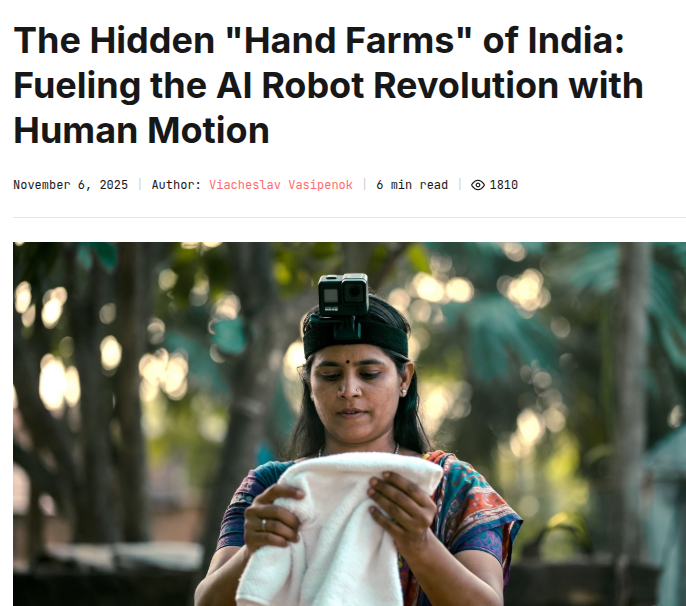
India is quietly becoming a training floor for humanoid robots. Workers film thousands of first-person hand tasks so AI systems can learn grasping, folding, sorting, and tool use. This story is really about how the humanoid robot boom still depends on cheap, repetitive labor.

Public reporting indicates that India has become a major source of first-person robot-training video. Workers film household, factory, and logistics tasks so AI systems can learn manipulation skills. The coverage centers on egocentric data collection, where head-mounted cameras capture what a worker sees and does.1
The work is concentrated in Indian hubs such as Tamil Nadu, Bengaluru, and Delhi. Workers are reported filming tasks such as slicing mangoes, tying shoes, making coffee, folding clothes, sorting goods, stacking boxes, and stitching garments.2
Some reports say workers are paid about ₹250 per hour, or roughly $2.40 to $2.62 per hour, for this footage. The relevant product is not a physical robot but egocentric robot-training data recorded from head-mounted cameras or phones strapped to the head.3
Understanding Egocentric Data Collection
The underlying training approach is called egocentric data collection. The camera captures the task from the performer’s point of view rather than from a third-person observer. The footage is broken into frames and annotated with hand movements, objects, and action steps so it can be used as machine-readable training data.
Sources describe the data as useful for teaching robots grasping, folding, sorting, tool use, and other manipulation skills. One source says some crews use lightweight RGB-D cameras, while others use ordinary smartphones or iPhones strapped to the head.1
Impact on Workers and Future Jobs
The main intended use case is training humanoid robots and other physical AI systems to perform real-world manipulation tasks in homes, factories, and warehouses. Sources frame the work as labor that may help teach machines to do the same jobs currently done by human workers.2
What does it mean for people to help accelerate the development of robots–the same people who are concerned about losing their jobs to robots. Reporting says the collected data is being sold to AI companies developing robots for factories and warehouses.
Paths Forward / Looking Ahead
The coverage links this trend to humanoid robots that may eventually perform household and industrial chores such as cooking, laundry, and sorting. One source describes the data as part of a growing global push to build systems that can learn human-like physical behavior from video, suggesting expansion beyond India if the market grows.3 This raises questions about how societies will balance the benefits of automation with the need to support displaced workers through retraining programs and new job creation in tech oversight roles.
Companies building humanoid robots need large real-world movement datasets to improve task performance. The broader competitive context shows that demand for such data will likely continue as firms seek to deploy robots in more settings. Policymakers may need to consider regulations around data collection labor practices to ensure fair pay and working conditions as this industry expands.
Related Articles
- Mumbai’s Vanar Robots Debuts Vanar Generation 1 Humanoid Prototype
- Humanoid Robots Advance in Manufacturing: From Excavators to Potential Self-Replication
- When Humanoid Robots Swap Kicks for Chores
- 2025: AI Titans Charge into Humanoid Robots and Stack Supremacy
Leave a Reply