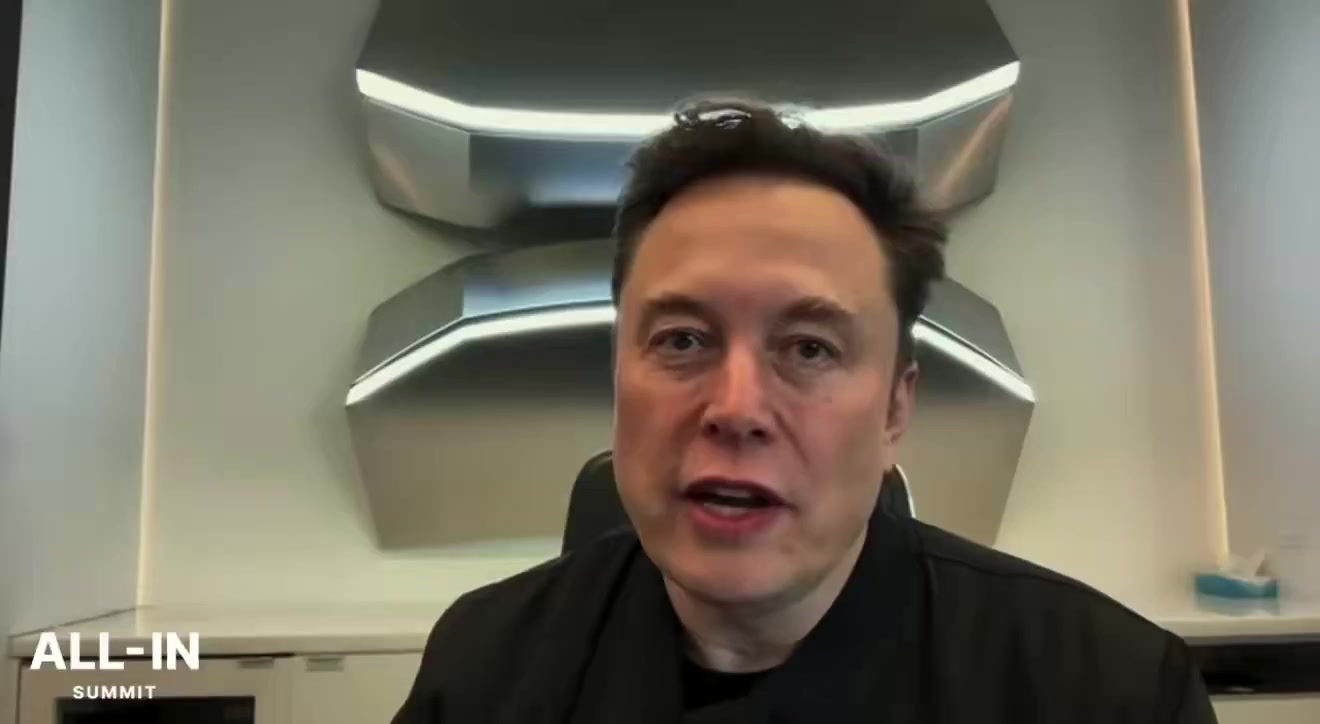
On February 13, 2026, @TheCaptainEli posted an 88-second clip of Elon Musk explaining why Tesla’s Optimus humanoid robot is so hard to build.1 The line that traveled was short: “The hands inclusive of the forearm are a majority of the engineering difficulty of the entire robot.”2 By mid-November the post had passed 15.6 million impressions and 10,900 likes.1
The footage itself is older. Musk said it over a video link from Tesla’s engineering headquarters in Palo Alto, during an All-In Summit interview that the All-In podcast released on September 9, 2025.234 More than a year later the sentence still holds, and it raises a fair question: why can robots now run and flip while their hands still lag so far behind?
Video: All-In Podcast footage of Elon Musk at the All-In Summit (Sept. 2025), as shared by @TheCaptainEli.
What Musk Actually Said
The hands remark closed a longer answer. Asked why the hand matters so much, Musk pointed out that most of the muscles that move your fingers sit in your forearm and pull on tendons, so the hand is “mostly a puppet.”2 He put the human hand at “27 or 28 degrees of freedom,” depending on how you count, and said a general-purpose humanoid “must solve the hands problem.”2
A degree of freedom is one independent way a joint can move, like a knuckle bending or a thumb swinging across the palm. Musk said Tesla could not buy suitable actuators, the motors, gearboxes, and control electronics that drive each joint, “for any amount of money,” so it designed them from physics first principles.2 Earlier in the same interview, while discussing cost, he said there are 26 actuators per arm.2
One correction to how the clip has been shared. The caption on the viral post quotes Musk as saying Optimus sits “somewhere between Model X and Starship.”1 In the interview, that phrase is a host’s summary, offered after Musk said Optimus is significantly harder than the Cybertruck, the Model Y, a Gigafactory, or the Model X, but that Starship is harder still.2 The point survives, but the words belong to the host.
Why the Hand Is So Hard to Copy
Each of your hands has 34 muscles, and they work with extrinsic muscles in the forearm to give the hand its strength and dexterity.5 The hand is also packed with sensors. A classic 1979 study by Roland Johansson and Åke Vallbo estimated 241 touch-sensing nerve units per square centimeter at the fingertip, compared with 58 in the palm.6
Robot hands that try to match this get complicated fast. The Shadow Dexterous Hand, a long-running research benchmark, uses 20 motors and tendons to drive 20 actuated degrees of freedom plus four underactuated movements across 24 joints, with more than 100 sensors and a weight of 4.3 kilograms.7 Every motor, cable, and sensor in a package that small is one more part that can stretch, wear, or fail.
Tesla’s approach, as Teslarati described patent filings published in April 2026, copies the human layout. The actuators sit in the forearm, three tendon-like cables per finger run through the wrist, and each finger gets four degrees of freedom with two more in the wrist.8 A patent is not a product, though, and Tesla has not published final hand specifications for Optimus V3.
Why Legs Got Easier First
This is the part that surprises people. For decades, walking looked like the hard problem. Then researchers learned to train walking controllers in simulation and transfer them to real robots, helped by deep learning, faster simulators, and cheaper hardware.9
The speed-up was dramatic. In one study, Nikita Rudin and colleagues trained the four-legged ANYmal robot on a single workstation GPU, with thousands of simulated robots practicing in parallel, and produced walking policies for flat terrain in under four minutes and for uneven terrain in twenty.10 A technique called domain randomization helps those policies survive the jump to reality: engineers vary physical settings such as friction and mass during training so that the real world falls inside the range the robot has already seen.9
Hands don’t get the same break. Feet meet the ground at a few predictable points, while fingers make many small contacts with objects whose shape, weight, and slipperiness are uncertain. Researchers have measured significant discrepancies between simulators and the real world on manipulation tasks.11 Even a 2025 paper on sim-to-real training for humanoid hands noted that the method had “mostly succeeded in simpler state-based or single-hand setups.”12
Scientists have a name for this pattern. Moravec’s paradox holds that skills we find effortless, like perception and movement, are far harder for machines than skills we find hard, like chess. As one Nature Machine Intelligence editorial put it, that may explain why it is easier to build an AI that finds the best chess move than a dexterous robotic hand that can pick up the pieces.13
Progress Is Real, but Slow
Dexterity is improving. In 2019, OpenAI trained a humanoid robot hand entirely in simulation, using a method it called automatic domain randomization, and used it to solve a Rubik’s cube on a real robot.14 In March 2025, Google DeepMind said its Gemini Robotics model could handle tasks such as origami folding and packing a snack into a Ziploc bag, while noting that many everyday tasks “are still too difficult for robots.”15
Touch is getting attention, too. Figure says each fingertip sensor on its Figure 03 hands, introduced in October 2025, can detect forces as small as three grams, about the weight of a paperclip, and that each hand carries a palm camera for when the main cameras are blocked.16 Those are company claims, but they point to the same lesson: a useful hand has to feel, not just move.
What the Replies Got Right
The thread under the clip pushed back in useful ways. @North_Lites asked why robots get only five fingers when a couple more might add function.17 @javadisciple answered with the practical case: a humanlike hand lets a robot use anything built for people to use.18 That is the bet behind humanoid robots in general.
@imtiaZ_btc focused on touch, arguing that without instant tactile feedback, even sophisticated actuators are “essentially operating in the dark” and can crush a delicate object.19 In a related thread, @FiftyOne_50_ wrote that humanoid robotics “isn’t compute-limited. It’s contact-limited.”20 Those two replies describe the research problem better than most press releases.
Others warned against treating hands as the whole story. @timmur_ argued that brushing off the robot’s mind is a mistake, since today’s AI still can’t learn on the fly.21 He has a point. On Tesla’s October 2026 earnings call, Musk himself said there is “still quite a lot of work to do with regard to the AI.”22
Some replies were about people. @JenHMM asked whether the technology could help people with spinal cord injuries who have reduced use of their hands, like her son.23 @MrHarmoniouis predicted that once hands are solved, blue-collar jobs will join white-collar ones on the automation line.24 Both questions deserve real answers, and they are a big reason we keep coming back to hands.
Where Optimus Stands Now
In its third-quarter update, released October 21, 2026, Tesla said Optimus production had begun on high-volume lines in Fremont, California, and called the units “the first production-quality bots that we have manufactured.”2526 Musk described it as early production and said reaching 20,000 units a week would take “at least a year, maybe a little longer.”22
The hand is still the holdup. Asked what remains, Musk said “it’s mostly the hand,” because human fingers are squishy, sensor-rich, and self-repairing, while a robot hand has to survive wear and tear without damaging its sensors.22 He said Tesla is “building robots that do not have perfected hands” while training continues, and that he expects to start delivering Optimus to outside companies around the end of 2027.22
The Last Mile of Robot Value
In January, reacting to Sharpa’s hand demo at CES, we called robot hands the “last mile” of value delivery: the robot handles the gross positioning, and the hands do the work.27 Musk’s line puts an engineering weight on that idea. Legs move the robot. Hands are where it earns its keep.
That framing explains the economics, too. A robot that walks to a workstation but can’t handle the parts there is a demo. One that can grip, turn, and place without crushing is a worker.
Looking Ahead
Watch three things over the next year. First, whether Tesla shares real hand specifications or performance data when it finally shows Optimus V3. Second, whether fingertip sensing like Figure’s three-gram sensors holds up after months of use, which is exactly the durability problem Musk described.2216 Third, whether the simulation methods that transformed walking start working as well for contact-rich hand tasks.12
For everyone else, the takeaway is simple. The next time a humanoid video shows a robot running or dancing, look at its hands. If they are only waving, the hard part is still ahead. Thanks to @TheCaptainEli for resurfacing the clip, and to Tesla and the All-In podcast for the original conversation.
Related Articles
- Why Dexterous Hands Are the Key to Unlocking Robot Potential
- Sharpa Robotics Hands: Revolutionizing Dexterity at CES
- MANUS Data Gloves Capture Every Finger Movement
- Dexterous Hands Turn Lunar Rovers Into Workers
Sources for this article
- Captain Eli (@TheCaptainEli) on X: Elon Musk on why Optimus is so hard to build, hands clip (Feb 13, 2026)
- Happy Scribe, transcript: All-In, Elon Musk on DOGE, Optimus, Starlink Smartphones, Evolving with AI, Why the West is Imploding
- All-In Podcast (@theallinpod) on X: Elon Musk at the All-In Summit, full interview (Sep 9, 2025, U.S. time)
- All-In with Chamath, Jason, Sacks & Friedberg, episode page: Elon Musk on DOGE, Optimus, Starlink Smartphones (listed Sep 10, 2025)
- Cleveland Clinic, Anatomy of the Hand and Wrist: Bones, Muscles and Ligaments
- Johansson RS, Vallbo AB, Tactile sensibility in the human hand: relative and absolute densities of four types of mechanoreceptive units in glabrous skin, Journal of Physiology (1979)
- Shadow Robot Company, Shadow Dexterous Hand Series (specifications)
- Teslarati, Tesla Optimus V3 hand and arm details revealed in new patents (Apr 16, 2026)
- Ha, Lee, van de Panne et al., Learning-based legged locomotion; state of the art and future perspectives (arXiv 2406.01152, v2 Nov 2024)
- Rudin, Hoeller, Reist, Hutter, Learning to Walk in Minutes Using Massively Parallel Deep Reinforcement Learning, Proceedings of Machine Learning Research vol. 164 (CoRL)
- Collins, Howard, Leitner, Quantifying the Reality Gap in Robotic Manipulation Tasks (arXiv 1811.01484, 2018)
- Sim-to-Real Reinforcement Learning for Vision-Based Dexterous Manipulation on Humanoids (arXiv 2502.20396, CoRL 2025)
- Nature Machine Intelligence, Materializing artificial intelligence (editorial, Nov 2020)
- OpenAI et al., Solving Rubik’s Cube with a Robot Hand (arXiv 1910.07113, 2019)
- Google DeepMind, Gemini Robotics brings AI into the physical world (Mar 12, 2025)
- Figure AI, Introducing Figure 03 (Oct 9, 2025)
- Reply by @North_Lites: why give robots only five fingers?
- Reply by @javadisciple: so the robot can use anything built for a human
- Reply by @imtiaZ_btc: the tactile sensing needed to not crush a delicate object
- Reply by @FiftyOne_50_ (related thread): humanoid robotics is contact-limited, not compute-limited
- Reply by @timmur_ (related thread): hands are hard, but so are minds
- The Motley Fool, Tesla (TSLA) Q3 2026 earnings call transcript (call held Oct 21, 2026)
- Reply by @JenHMM: could this help people with spinal cord injuries?
- Reply by @MrHarmoniouis: solved hands put blue-collar jobs on the automation line
- Tesla, Q3 2026 Update (shareholder deck, SEC exhibit 99.1)
- TechCrunch, Tesla starts Optimus robot production in California as profit falls 43% (Oct 21, 2026)
- Robot Central (@RobotCentral) on X: robot hands are the “last mile” of value delivery (Jan 8, 2026)
Leave a Reply