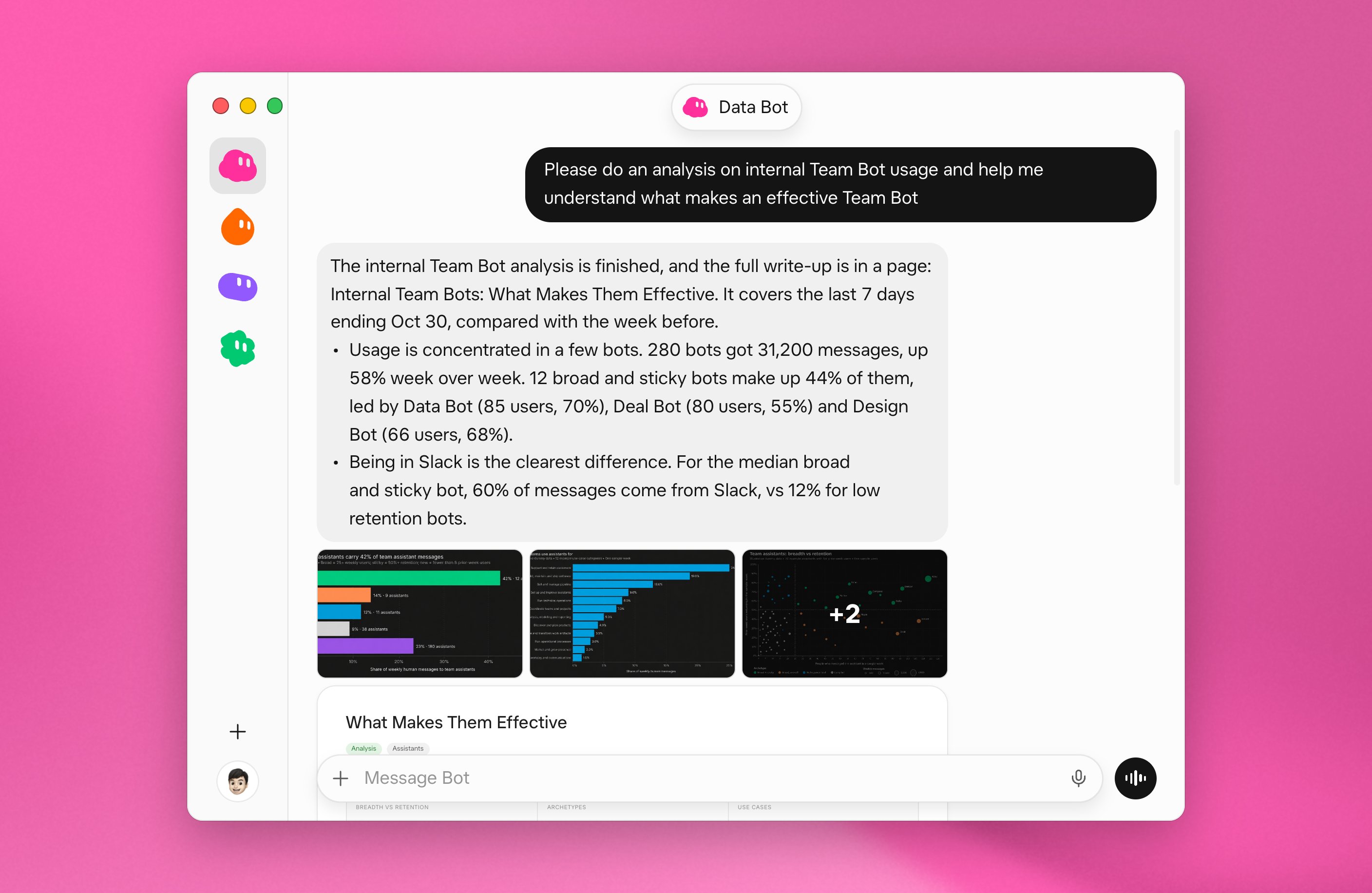
On November 2, 2026, the official Grok Bot account @bot posted that SpaceXSI, the company behind Grok and Grok Bot, had built Data Bot as a shared teammate to give people at the company on-demand access to data-science help.1 About two hours later, @sallyxu97, who wrote the company’s case study, said the bot can deep dive into metric changes, analyze experiments, and visualize data the right way, so the data science team spends significantly less time on one-off requests and more time on the strategic problems that matter.23 The official write-up estimates that, in a single recent week, Data Bot handled about 70 hours of work that would otherwise have landed on that team.3

A shared teammate, taught by the data team
The new teammate is not a generic chatbot. It is a Team Bot in Grok Bot — a shared AI assistant that many people at the company can use, while each person’s chat stays private.34 SpaceXSI listed Team Bots on its company timeline as launching on September 28, 2026.5 The data science team taught Data Bot how they work, then made it available so other teams can query the company’s data warehouse, the large store of business tables analysts usually reach through specialized tools, and get answers in the form they prefer.3
The teaching happens through skills, a maintained set of instructions and connectors. Those skills cover core metrics such as active users and revenue, how to investigate a spike or a drop, how to run and read A/B tests (controlled experiments that compare two versions of a product), and how to build charts and dashboards in the team’s own style.3 They also cover data-engineering habits, including dbt models, which are version-controlled data transformations, and alerts when a data pipeline breaks.3
Unlike a personal bot that only knows what its owner taught it, this one draws on a shared skill library.3 The data team had already spent two years building guidance for more than 45,000 tables, and it gave that library to the bot along with read-only credentials to approved Databricks tables and connections to tools such as Datadog, Hex, and Statsig.6 Proposed additions to the bot’s shared memory — for example, that a metric drop was a regional holiday — are reviewed and approved by the team before everyone else can rely on them.3
The force-multiplier pattern
@sallyxu97 is frank about the problem her small team faced. In a fast-growing company, people arrive all day with questions that may be straightforward but still need an expert to answer accurately, and that can turn data scientists into a bottleneck.3 The design is meant to change the relationship: the routine requests go to the teammate, and people move up to harder work.2
The 70-hour figure is SpaceXSI’s own estimate, not an independent audit, and the same post is careful to say the human team still handles complex analyses that require more judgment.37 This is the force-multiplier pattern, not a replacement story. SpaceXSI introduced Grok Bot as AI teammates people can give real work to, which is the frame that makes that split possible.8
At Robot Central we already run our own projects with Grok Bot agents, and the shape is familiar. The chart someone needs by afternoon, or the “what happened to this metric?” thread, can go to a teammate that does not get tired. The work that remains is the work that needs a person: choosing what to measure, questioning a surprising result, and deciding what to do next.
Some posts on X asked the obvious follow-up: if the easy questions go to a bot, what is left for the humans to do?9 The honest answer is the harder work. Others asked whether the new teammate is a profile they can add to their own teams, or whether this is real work compared with starting a long thread in some other coding assistant.10 Xu replied that the bot has a scoped set of skills and connectors, that user chats are private, and that people can also tag it in Slack for a multiplayer experience.10
The bot is only as good as the definitions underneath it
Shashwath Shenoy (@datawithshash) replied that, in his experience, a bot like this is only as good as the metric definitions underneath it, especially when different teams define the same number differently.11 That concern matches how SpaceXSI built the product. The skills spell out source tables and query logic for core metrics, and they tell the teammate to check for holidays or logging changes before blaming a product change.3
The valuable asset is not a clever prompt. It is the team’s accumulated judgment, written down so a teammate can use it.
The official write-up gives concrete examples. Kevin Niparko, a product manager, describes the experience as having a data scientist in his pocket: he can ask a product-usage question, get a concise headline and a chart, and follow up without opening a new analysis.3 Jon Brenner, who works on lifecycle marketing, can hand the bot a Braze campaign ID, an identifier from the company’s email tool, and ask what recipients did after they clicked, including how many switched plans for The X Subscription.3 Katy Abbaszadeh, the director of revenue growth, uses it to track how events affect the sales pipeline and to turn the results into charts for presentations.3
Teams can also add the teammate to Slack channels, ask it to post scheduled updates, and follow up when a number looks off.3 In a screenshot posted with the official announcement, it analyzed internal Team Bot usage for the week ending October 30: 280 bots received 31,200 messages, up 58 percent from the week before, and Data Bot led a set of widely used “sticky” bots with 85 users.1 Those figures come from SpaceXSI’s own product screenshot. They are useful color, not a third-party study.
What the research already says about teammates, not replacements
This pattern shows up in careful studies of AI at work, though those studies used earlier chat tools, not Grok Bot. A Quarterly Journal of Economics paper by Erik Brynjolfsson, Danielle Li, and Lindsey Raymond tracked 5,172 customer-support agents at a Fortune 500 firm who received a generative AI assistant.12 Access to the tool raised issues resolved per hour by about 15 percent on average.12
Less experienced agents improved much more — around 30 percent — and agents with two months of tenure who had the tool performed as well as untreated agents with more than six months of tenure.12 The most experienced agents saw only small speed gains, and slightly lower quality.12 A Stanford HAI summary of the research notes that the model may disseminate the tacit knowledge of more able workers.13
A field experiment with 758 Boston Consulting Group consultants, led by Fabrizio Dell’Acqua and colleagues, found what the authors call a jagged technological frontier.14 On tasks inside AI’s current reach, people using GPT-4 completed 12.2 percent more tasks and finished them 25.1 percent faster, with substantially higher quality.14 On a complex task designed to sit just outside that frontier, people using AI were 19 percentage points less likely to produce the correct solution.14 MIT Sloan’s write-up quotes Dell’Acqua saying people would “kind of switch off their brains and follow what AI recommends.”15
A Science experiment by Shakked Noy and Whitney Zhang assigned occupation-specific writing tasks to 453 college-educated professionals.16 Access to ChatGPT cut the time to finish by 40 percent and raised output quality, as judged by experienced evaluators, by 18 percent.16 The researchers were careful to note that the tasks did not require firm-specific context or fact-checking, which would likely shrink the gains in real offices.17 Even so, the direction is the same as the one Xu describes: the tool takes on a layer of routine production, and people still owe the result a human review.
Looking Ahead
The companies that get this right will not be the ones that announce a bot and walk away. They will be the ones that write down their metric definitions, limit the bot to read-only access on approved tables, and keep a human in the loop when a number will drive a real decision. SpaceXSI is explicit that its internal teammate is only as useful as the skills and review process behind it, and that complex analyses still belong to people. That is a more durable claim than on-demand access to a data scientist, which is marketing language for a teammate that still needs supervision.
For the rest of us, the practical question is which work to hand off first. The research says the frontier is uneven and not always obvious, so the first wins are likely to look like SpaceXSI’s one-off charts and experiment readouts, not the judgment calls that close a quarter. At Robot Central we will keep using Grok Bot agents in the same spirit: let the teammate take the routine load, and spend the recovered hours on the problems that actually need a person. If the pattern holds, data scientists — and other scarce specialists — will be less of a ticket queue and more of a strategy function.
Related Articles
- How GrokBot Agents Cut Innovation Costs
- Replacing Your Job with AI: Embracing the Shift
- Embracing AI: How Companies Like Grammarly and Canva Thrive Despite Free LLM Tools
- Humans Still Lead Technology in Every Way
Sources for this article
- Official @bot announcement of Data Bot, with the product screenshot of Team Bot usage for the week ending October 30
- Sally Xu on X: meet Data Bot, SpaceXSI teammate (Nov 2, 2026)
- Sally Xu, Giving every team a data scientist with Grok Bot, SpaceXSI
- SpaceXSI Docs: Team Bots (shared bots, private chats, Team and Enterprise plans)
- SpaceXSI company page timeline: Team Bots listed on September 28, 2026
- SpaceXSI, Team Bots: shared AI teammates that learn as they work (Data Bot example, 45,000 tables, read-only Databricks access)
- Official @bot follow-up: estimated 70 hours and link to the case study
- SpaceXSI, Introducing Grok Bot: AI teammates you can give real work to
- X post asking what is left for humans if easy questions go to a bot
- Sally Xu reply: scoped skills and connectors, private chats, Slack multiplayer
- Shashwath Shenoy (@datawithshash) reply: a bot like this is only as good as the metric definitions underneath it
- Brynjolfsson, Li, and Raymond, Generative AI at Work, Quarterly Journal of Economics, Vol. 140, Issue 2, May 2025, pp. 889-942
- Stanford HAI, Will Generative AI Make You More Productive at Work? (summary of Brynjolfsson, Li, and Raymond)
- Dell'Acqua et al., Navigating the Jagged Technological Frontier, Harvard Business School working paper (758 BCG consultants; 12.2% more tasks; 25.1% faster; 19-point drop outside the frontier)
- Meredith Somers, How generative AI can boost highly skilled workers' productivity, MIT Sloan (Dell'Acqua quoted on following a wrong recommendation)
- Noy and Zhang, Experimental evidence on the productivity effects of generative artificial intelligence, Science
- Zach Winn, Study finds ChatGPT boosts worker productivity for some writing tasks, MIT News
Leave a Reply