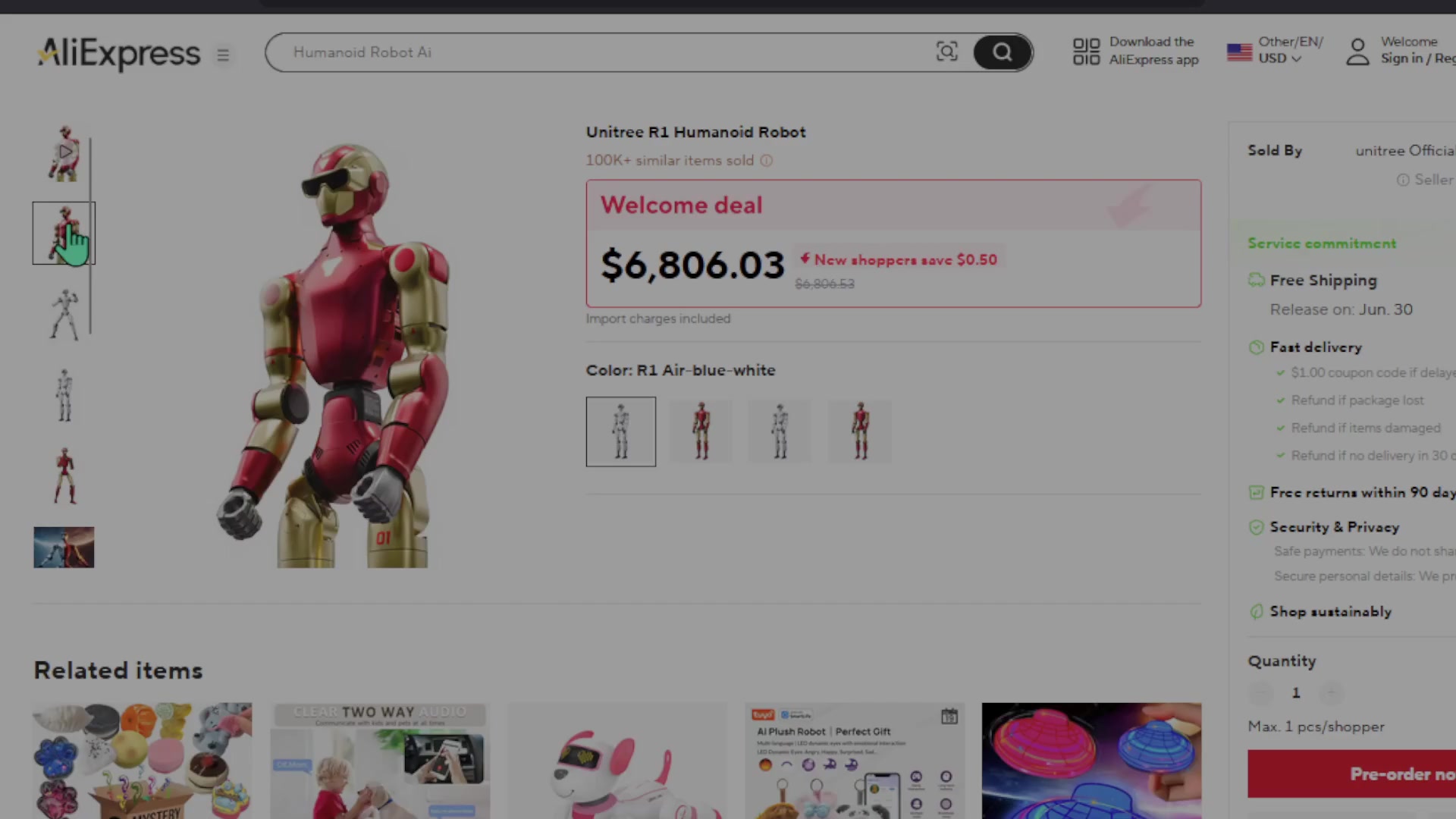
The Unitree R1 Humanoid Robot has hit the market at a starting price near $6,800 on some platforms. This move puts serious pressure on other makers who charge far more for similar machines. Unitree aims to make advanced robotics available to more buyers than ever before.
Official listings show the R1 AIR version begins at $4,900 while the standard model starts at $5,900.1 The robot stands about 1.23 meters tall and weighs between 25 and 29 kilograms depending on the version. These numbers make it one of the more compact options in the current lineup of humanoids.
Buyers can choose from AIR, standard, and EDU configurations that adjust the number of degrees of freedom from 20 to 26.2 The design uses low-inertia motors and supports quick battery swaps for roughly one hour of runtime. Developers get SDK access especially on the higher EDU models that can include optional NVIDIA compute.
Compared with other humanoids the R1 price looks like a fraction of typical costs.3 Many competing machines still sit well above $20,000 or even $100,000. Unitree’s approach shows how quickly prices can fall when production scales and competition heats up.
This price trend follows the same pattern Moore’s law described for chips. Processing power and now robot hardware keep getting cheaper over time. Lower entry points mean more labs, schools, and small teams can experiment without huge budgets.
The R1 supports agile moves such as running, cartwheels, and recovery from falls.4 It also includes voice and image recognition features in its multimodal setup. These capabilities target education, research, and light development work rather than heavy industrial tasks right away.
Retail pages list six degrees of freedom per leg and five per arm on the standard model along with two waist and two head joints on upgraded versions.5 Crossed roller bearings help keep motion smooth and reliable. The overall focus stays on natural movement in everyday settings.
Applications center on developers and STEM programs that need an affortable test platform.6 Unitree positions the robot for complex scenarios where perception and basic mobility matter most. Broader access could speed up real-world trials across many groups.
Future versions may add more compute options and refined software stacks. The current spread of configurations already hints at an upgrade path for users who start small. This setup keeps the door open for iterative improvements without forcing buyers into one rigid model.
Paths Forward / Looking Ahead
Lower prices like the one on the Unitree R1 Humanoid Robot could pull in new users who previously stayed on the sidelines. Schools and early startups gain a practical way to test ideas without waiting for grants or big funding rounds. Over time this wider pool of experimenters may uncover uses that larger teams have overlooked so far.
At the same time the market must balance speed with safety and support. Cheaper hardware still needs solid documentation and community resources if adoption is to last. Companies that pair low cost with clear upgrade routes stand the best chance of building lasting interest in humanoid platforms.
Related Articles
- Unitree R1: Affordable Humanoid Robot Revolutionizing Warehouse Labor
- Unitree R1 Development Kit Launched: ¥2 Million Entry Point for Humanoid Robotics Innovation
- Exploring the Future of Robotics: Unitree’s Dancing Marvel and AI Synergies
- Revolutionizing Robotics: OpenMind AGI and Unitree’s Partnership for Open-Source Innovation
Leave a Reply