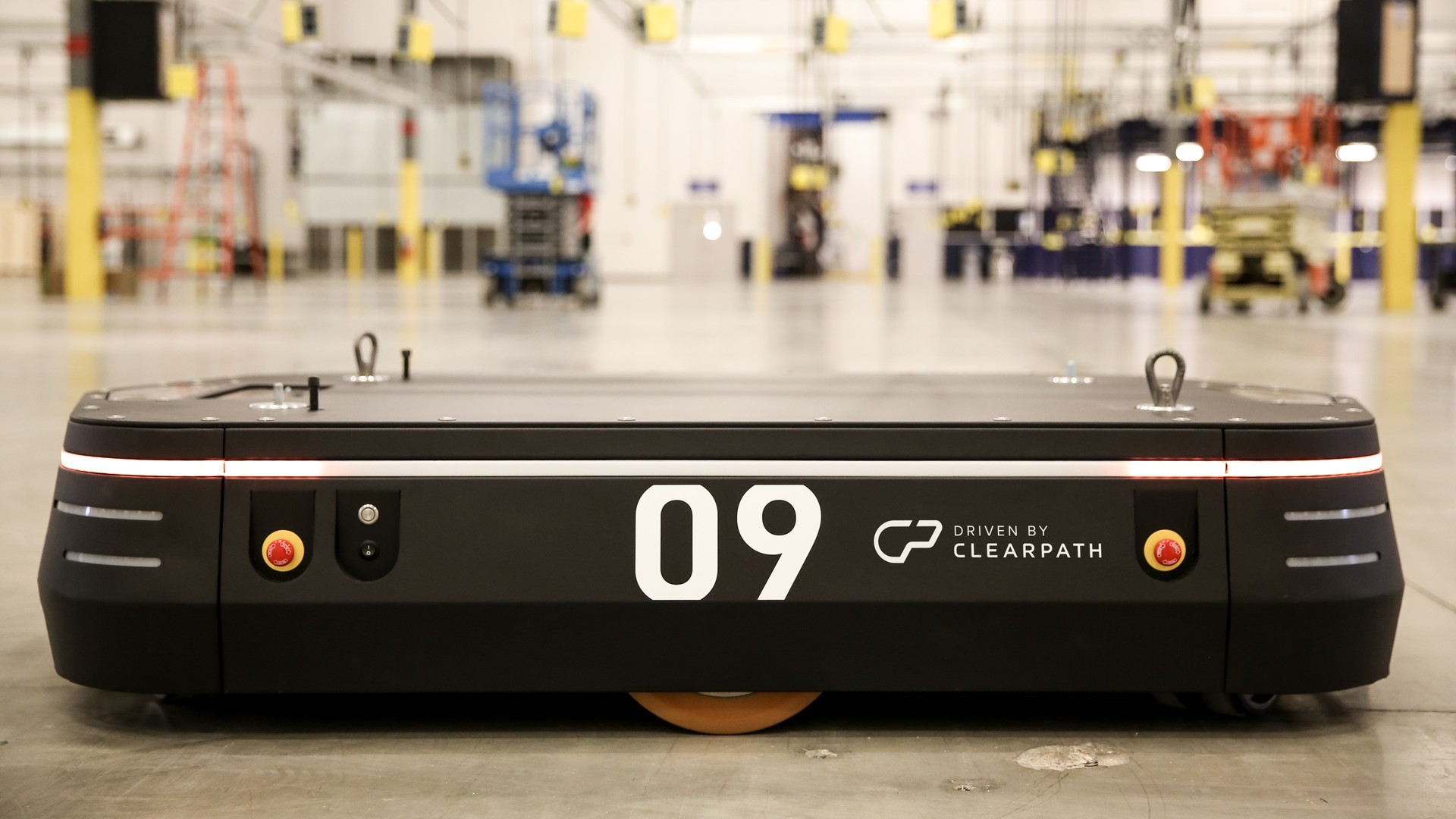
Warehouse robot ROI is the return a facility earns on robots, software and integration, usually written as benefits minus costs, divided by costs. Most buyers, though, manage the decision as payback in months: how long until net annual savings cover the all-in investment. An honest model uses fully loaded labor, a three-to-six-month ramp, and integration costs that often rival the hardware, not the robot’s sticker price alone, a gap that also defines cobot financing.
An autonomous mobile robot, or AMR, navigates with onboard sensors rather than the floor tape or wires that guided earlier automated guided vehicles. AMRs sit alongside goods-to-person systems, automated storage and retrieval systems (AS/RS), conveyors, and the warehouse management software, or WMS, that assigns work. There is no single payback number for “warehouse robots.” The figure depends on the job, the shifts, and whether the quote includes the unglamorous lines.

How to calculate warehouse robot ROI
Finance usually asks for two numbers. Period ROI is cumulative net savings minus the upfront investment, divided by that investment, over a chosen horizon, often five years. Payback, in months, is the upfront investment divided by annual net savings, times 12. That second number is the one most operations and finance teams actually argue about.
Upfront cost should include robots or other equipment, fleet and WMS software, integration, site work, commissioning, training, and internal project time. Net savings are labor that will actually leave payroll or never be hired, plus measurable gains in accuracy, damage and avoided overtime, minus annual service, licenses, and the technicians who keep the fleet running. Hours that look busy in a simulation but do not come off the schedule do not count. If savings ramp slowly after go-live, year one should be modeled on its own, not blended into a flattering average.
Payback ranges by system type
Every range below is someone else’s figure, with a date and a label. None of them is a promise for the next building.
In 2026, L.E.K. Consulting surveyed 200 warehouse automation decision-makers. Respondents said they had realized roughly a 20 to 40 percent return, and more than 80 percent of operators reported payback under two years, from labor savings, throughput, less damage, and lower operating costs.1 Those are self-reported results, not audited project books, from people who already buy this equipment.
Actel Robotics, a vendor, published a compiled “Warehouse Automation ROI Benchmark 2026” on July 30, 2026, drawing on published research, vendor benchmarks, and its own work, framed for Gulf Coast labor rates. In that compilation, fulfillment AMRs used in order picking are often cited at about 18 to 24 months, conveyor and sortation at 24 to 36 months, and AS/RS at 36 to 60 months.2 Actel notes that payback varies more by what you automate than by where.
McKinsey, writing in September 2024, was more cautious. Only about 20 percent of warehouses in North America had adopted any form of automation, it reported, and “payback periods for projects are often longer than the lease on the building being automated.”3 Citing a market forecast, it projected that even at an 8.3 percent compound annual growth rate, only about a quarter of those warehouses would have some automation by 2027.3 Its case sketches—a grocery retrofit with 20 percent run-rate savings and a fourfold rise in productivity, and a logistics company that piloted 1,000 AMRs with picking productivity up 200 percent—are consultant-reported, not a guarantee for the next fleet.3
A named example at a different point on the spectrum is DCL Logistics. In a Universal Robots case story, DCL executives said a UR10e cobot cell used to pick, scan and pack—not an AMR fleet—delivered a three-month ROI, a 500 percent productivity increase, 50 percent labor-cost savings, and order accuracy of 100 percent, up from 99.5 percent.4 That is DCL’s account of one cobot cell. It should not be averaged into an AMR or AS/RS payback.
Costs that get left out of vendor models
Public contracts are useful because they are not marketing slides. Heriot-Watt University’s Annual Procurement Report for 2023-24 lists a March 4, 2024, contract described as “Purchase of MiR25 Base Robot” at £110,369, and a January 30, 2024, contract for a Robotnik “RB VOGUI Mobile Robot” at £92,065.5 The report does not itemize chargers, software, training or maintenance, and the Mobile Industrial Robots line is written as “MiR25.” A single industrial mobile robot, bought through a regulated public process, can still land around £90,000 to £110,000 before anyone promises a fleet.
Chargers, maps, wireless coverage, attachments, safety work, training, and a hook into the existing WMS arrive as separate lines, as does commissioning time. Fraunhofer IML’s WMS Market Report Compact 2024 found that a WMS for a manual warehouse typically costs €50,000 to €300,000 and takes three to nine months. In automated warehouses, about 36 percent of projects landed between €300,000 and €500,000, and 43 percent of providers planned on nine to twelve months.67 If the robots cannot talk cleanly to the WMS, the labor savings on the slide do not show up on the floor. Pallet-level robots aimed at existing aisles, such as Filics's machines for the pallet move, are being watched in part because they try to keep that integration closer to software than to a building rebuild.
Labor, throughput and error savings
Most cases stand or fall on labor. In May 2025, the U.S. Bureau of Labor Statistics put the median wage for laborers and freight, stock, and material movers in warehousing and storage at $22.06 an hour, or $45,880 a year, with stockers and order fillers at $21.49 and industrial truck operators at $23.16.8 By September 2026, average hourly earnings for all employees in the industry had reached a preliminary $26.87. The industry employed about 1.84 million people as of October 2026.8
Wages are not the employer’s full cost. In June 2026, BLS put total compensation in the broader transportation and warehousing industry at $49.86 an hour, of which $16.90, or 33.9 percent, was benefits.9 That series includes trucking, so it is not a price tag for a single picker, but it shows that benefits make up roughly a third of total compensation, or about half on top of pay. A model that divides a robot’s list price by a wage, and stops there, is a brochure.
Utilization is the other half of the ledger. A robot that covers work across three shifts has far more annual hours than the same machine on a day shift, and a fleet should not be modeled at 100 percent uptime. Charging, congestion, exceptions and maintenance all cut into the hours that actually move goods, which is why robots that can keep running through a battery swap matter to payback. Safety belongs here too. In 2024, warehousing’s rate of total recordable injuries and illnesses was 4.8 cases per 100 full-time workers, against 2.3 in all private industry; BLS’s 2025 industry snapshot put the warehousing rate at 4.5.810
Labor savings are not only headcount cuts. Operator's industrial robot for repetitive warehouse tasks is one example of the jobs companies try to take off people’s backs. DCL said workers could be moved to other services or trained to manage the machine.4 Amazon said on June 30, 2025, that it had deployed its one millionth robot, and that at its Shreveport, Louisiana, fulfillment center, advanced robotics required 30 percent more employees in reliability, maintenance, and engineering roles.11 An earlier look at automated warehouses made a similar point, one that also runs through our robots coverage: automation works best when it is designed together with the work that remains on the floor.
A short worked example
This example is illustrative, not a quote, a customer story, or financial advice. Use your own all-in bid and your own payroll.
Take the May 2025 median of $22.06 an hour for warehouse laborers.8 If benefits were 33.9 percent of total compensation, as in the June 2026 transportation-and-warehousing series, an illustrative fully loaded rate would be about $22.06 divided by 0.661, or roughly $33.40 an hour, and about $69,500 a year at 2,080 hours.9 That is a worksheet number, not an official BLS fully loaded wage for warehouse pickers.
Suppose, only for the arithmetic, that an all-in installed AMR project is quoted at $1.2 million, and that after a three-to-six-month ramp the site can avoid hiring or replacing six full-time roles, a gross saving of about $417,000 a year. If service and licenses were $80,000 a year, net savings would be about $337,000, and simple payback would be about 43 months. If the same fleet covered those roles across additional shifts and net savings rose to $600,000, payback would fall to about 24 months. Change the quote, the FTE count, or the ramp, and the date moves. That sensitivity is the point of the exercise.
Looking Ahead
The next few years of warehouse automation are less likely to be a contest of who has the most dramatic robot than of who can make mixed fleets, existing racks, and a stubborn WMS work as one system. L.E.K.’s respondents are already pointing their budgets at software and at upgrades inside buildings they already have: 65 to 70 percent of annual spend, the firm reported, now goes to smaller retrofit and brownfield projects.1 For most operators, the practical test remains blunt: will this fleet, in this building, on these shifts, beat the fully loaded cost of the work it is meant to take on?
Humanoid warehouse robots will keep drawing cameras, and they may yet change the labor equation in aisles built for people. The business risk around those machines is a separate story, as Agility Robotics' S-4 filing made plain. They should not delay the quieter arithmetic that AMRs, shuttles, and warehouse software already require.
FAQ
How long does it take for warehouse robots to pay for themselves?
There is no single warehouse robot payback period. In L.E.K.’s 2026 survey of 200 decision-makers, more than 80 percent of operators reported payback under two years, with returns of about 20 to 40 percent, but those figures are self-reported by companies that already automate.1 Actel’s compiled 2026 vendor benchmark often cites about 18 to 24 months for fulfillment AMRs and 36 to 60 months for AS/RS, while McKinsey has warned that some projects take longer than the lease on the building.23 A three-month ROI, such as the one DCL Logistics reported for a cobot packing cell, is a named-customer claim, not an industry average.4
How do you calculate warehouse robot ROI?
Period ROI is cumulative net savings minus the all-in investment, divided by that investment. Payback in months is the investment divided by annual net savings, times 12. Count robots, software, integration, site work, training, and internal time on the cost side, and only labor and errors you will actually stop paying for, minus service and licenses, on the savings side. Model year one separately if the ramp takes three to six months.
What costs get left out of vendor ROI models?
The usual holes are integration, facility preparation, WMS work, maintenance, software subscriptions, charging and downtime, commissioning, training, and the months before the fleet runs at the assumed rate. Public contracts show that a single mobile robot can already cost around £90,000 to £110,000, and Fraunhofer IML found that a WMS for an automated warehouse often lands in the mid-six figures and takes nine to twelve months to put in.56
Is an AMR a faster payback than an AS/RS system?
Often, on paper, because AMRs can be rolled into an existing building, while AS/RS is a denser, more capital-heavy facility project. Actel’s compiled ranges put fulfillment AMRs around 18 to 24 months and AS/RS around 36 to 60 months, and L.E.K. found that 65 to 70 percent of annual automation spend already goes to brownfield retrofits.12 If the AMR fleet is under-utilized, or the WMS hook is weak, the shorter range will not hold.
Do warehouse robots replace workers, or redeploy them?
Both happen, and the honest business case says which one it is counting. DCL said workers whose tasks were automated could be moved to other services or trained to maintain the robots.4 Amazon reported that its Shreveport robotics site needed 30 percent more people in reliability, maintenance, and engineering.11 U.S. warehousing still employed about 1.84 million people in October 2026.8 A model should not assume that every robot-hour erases a paycheck unless the schedule actually changes.
Related Articles
- Filics Robots Turn the Pallet Move Into a Software Job
- Operator Industrial AI Robot Handles Warehouse Repetitive Tasks
- The Next Era of Automated Warehouses
- Agility Robotics S-4 Filing Shows Financial Strain
Sources for this article
- L.E.K. Consulting, US Warehouse Automation's Next Act: A Broadening Automation Opportunity (Executive Insights, 2026; survey of 200 warehouse automation decision-makers).
- Actel Robotics, Warehouse Automation ROI Benchmark 2026 (compiled vendor benchmark by Dan Tarpey, last updated July 30, 2026). Vendor compilation, not an independent survey.
- Alberto Oca, McKinsey & Company, Navigating warehouse automation strategy for the distributor market (September 27, 2024). The 8.3 percent growth figure and 2027 share are attributed there to MarketsandMarkets, Automated Material Handling Equipment Market, Global Forecast to 2028 (2023).
- Universal Robots, DCL Logistics uses UR robot to increase productivity (company case story; figures are DCL’s claims about a UR10e cobot cell).
- Heriot-Watt University, Annual Procurement Report 2023-24 (approved October 30, 2024), Annex A, contracts HWU-UK 2324-194-00 (MiR25 Base Robot, £110,369, awarded March 4, 2024) and HWU-UK 2324-186-00 (RB VOGUI Mobile Robot, £92,065, awarded January 30, 2024).
- Fraunhofer Institute for Material Flow and Logistics IML, WMS Market Report Compact 2024 (DOI: 10.24406/publica-3936).
- Fraunhofer IML, Studie zu Trends im WMS-Markt veröffentlicht (press release, December 19, 2024).
- U.S. Bureau of Labor Statistics, Warehousing and Storage: NAICS 493 (May 2025 Occupational Employment and Wage Statistics; Current Employment Statistics through October 2026, preliminary where marked; 2025 Survey of Occupational Injuries and Illnesses rate).
- U.S. Bureau of Labor Statistics, Employer Costs for Employee Compensation, Table 4, private industry workers by occupational and industry group (June 2026).
- U.S. Bureau of Labor Statistics, Table 1. Incidence rates of nonfatal occupational injuries and illnesses by industry and case types, 2024 (last modified January 22, 2026).
- Scott Dresser, Amazon, Amazon launches a new AI foundation model to power its robotic fleet and deploys its 1 millionth robot (June 30, 2025).
Leave a Reply